
Quick Writes (also known as Timed Writings and Fluency Writes) are an indispensable tool in my classroom, and I was shocked to discover that in the life of this blogcito, I haven’t written about them yet! So, here’s the WHAT, WHY and HOW I use Quick Writes with my Little Darlings. And if you teach in a school that requires SLO or other weird acronym that require you to “prove” to your boss you’re doing your job with data and evidence, Quick Writes are a pretty painless way to achieve this.
What are Quick Writes?
They are short writing sessions where students write as much as they can (in the target language) in a limited amount of time. Some teachers give them 10 or 15 minutes to write, but I prefer 5 minutes, because I don’t have nearly enough time with my Little Darlings and spending long amounts of time writing is not worth it, in my not-humble-at-all opinion.
Rant: We know that output (writing and speaking) doesn’t build more language in their brains, output is just evidence of the language they’ve already acquired. For language to be acquired (that is, built in their brains), they need loads and load of input (reading and listening). So…with my precious time with my Little Darlings, I want to spend more time loading them up with comprehensible input and less time dedicated to output, which is why for me, 5 minutes reaches my goal and doesn’t sacrifice a too much input time. But, to each his own.
Some times teachers ask students to write about a topic (or retell a story) other times they can write about anything they want….the idea is that they write as much as they can, as fast as they can (without time to edit).
Why Quick Writes?
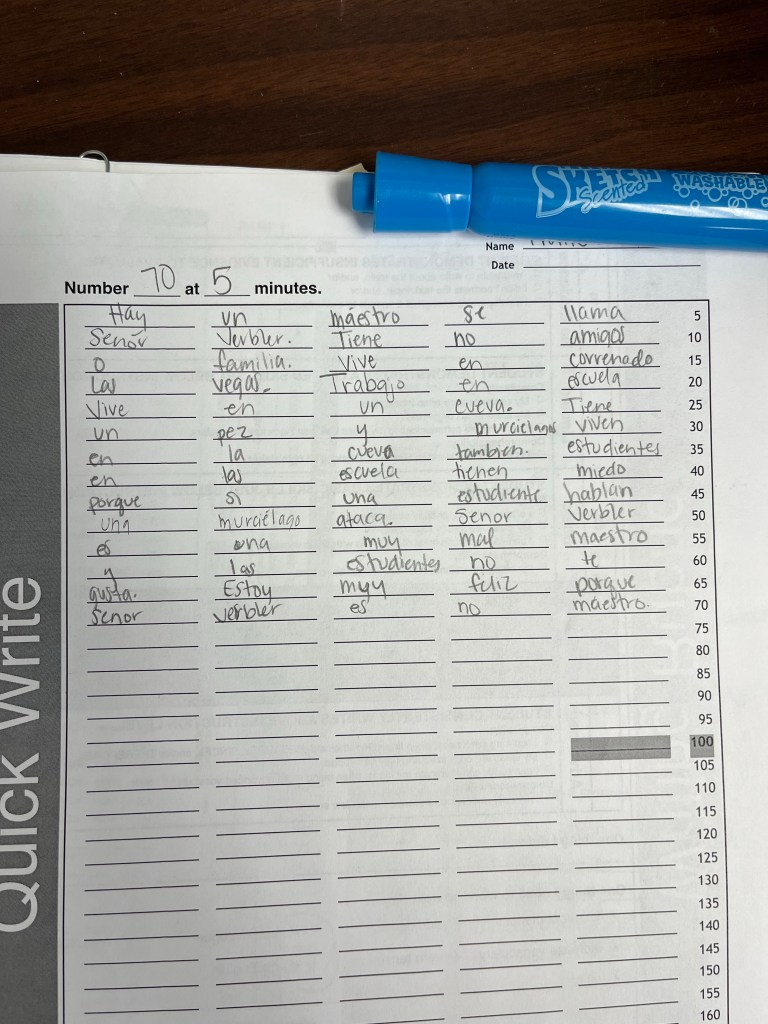
- So much of what we do in our classrooms is invisible. We can’t actually see or measure (although Lord knows we try!) the acquisition magic happening in their little brains. When we ask them to write as much as they can, as fast as they can, we get a peek into they language they’ve acquired. And maybe more important than us (the teachers) getting a peek, the students get to see that even when we’re laughing and chatting and “it doesn’t feel like we’re doing anything” in Spanish class, their brains are actually doing lots of heavy lifting, and Quick Writes are tangible proof of this. By compiling their Quick Writes over the year into a portfolio (more on that below), students, parents and administrators can marvel at how much language they’ve acquired in your class, by comparing their early Quick Writes to their end of the year Quick Writes. It feels good for them and makes you look good, too! Win-win!
- Since they don’t have time to labor over if it should be “habla” or “hablan”, they just write the first thing that pops in their heads, it gives us (their teachers) valuable information about what they’ve acquired and what they haven’t yet acquired. So…if I see a lot of variations of “Los chicos habla” in their writings, that is NOT an indicator that they need to learn about conjugation charts and do some drill and kill….it tells us they need lots more exposure of verb endings changing, and their attention to be drawn to HOW the verb endings change the meaning of the sentences, in the form of a “Grammar Pop Up” (POP UP Grammar: micro grammar explanations, in English, that attach meaning to form . It sounds like this, “See the N on the back of Hablan, that N means THEY, so what does Hablan mean? Yes! They talk” then you carry on in comprehensible Spanish or French or whatever. And the next time you see a plural verb, you ask, “Why is it corren and not corre? Tell your partner” and move on. )
- If your school thinks teachers don’t have nearly enough on their plates and should also spend their precious time compiling and analyzing student data to prove their worth, then Quick Writes is an easy way to play the game. Stick around, I have a whole section on that below. And if your school/district or state doesn’t require such additional busy work of teachers, consider yourself lucky and pray for the rest of us.
How to do Quick Writes:
Disclaimer: This section might be better titled, “How Sra Chase does Quick Writes” because there are a zillion variations and I can only speak to what we do at The Chase Place…if you do Quick Writes differently than I do Quick Writes, you just keep on doing what’s working for you 🙂
- They need something to write on and a writing implement. They could use plain paper, but I love Scott Benedict’s “Quick Write Paper 2016” (I think you will have to enter your email address to access the document in order to download it). I love this sheet because students write one word per line, so at the end of their writing session, they don’t need to waste time counting their words, because the word count is in the far right column. Easy peasy!

- Decide how much time you want to give them. It’s important to keep it the time limit the same throughout the year, so they’re comparing apples to apples when they look at their Quick Writes over the course of the year.
- Decide if you want to give them a topic or have them write about whatever they want. I prefer to ask them to retell a story we’ve done together in class, but they can totally make up details if they can’t remember something. I don’t want students spending a lot of time crafting a clever story or debating over the perfect name for their protagonist…I find when I don’t give them something specific to write about, they don’t write as much because they’re pondering the details.
- Remind them that their goal is to write as much as they can, as fast as they can! Set the timer and they’re off! I’m obsessed with YouTube timers.
- I personally don’t help with specific words during their Quick Writes because then everyone wants vocab help and they’re waiting for you with their hand up in the air instead of writing madly. I just tell them, “Use words you know” and walk away; I’m mean like that.
- Once the timer sounds, I encourage them to finish their sentence, then count their words.
- They record their data in their portfolios, so we can watch their word count and writing complexity grow over the course of the year. Print out this sheet for students: Quick Write Data Tracker. On the front, they should record the date, their word count and check the boxes that best describe the complexity of their writing:

- On the back, show them how to plot a point to represent their word count. Next time, they’ll draw a line connecting their points to create a visual representation of their growth over the the course of the year.
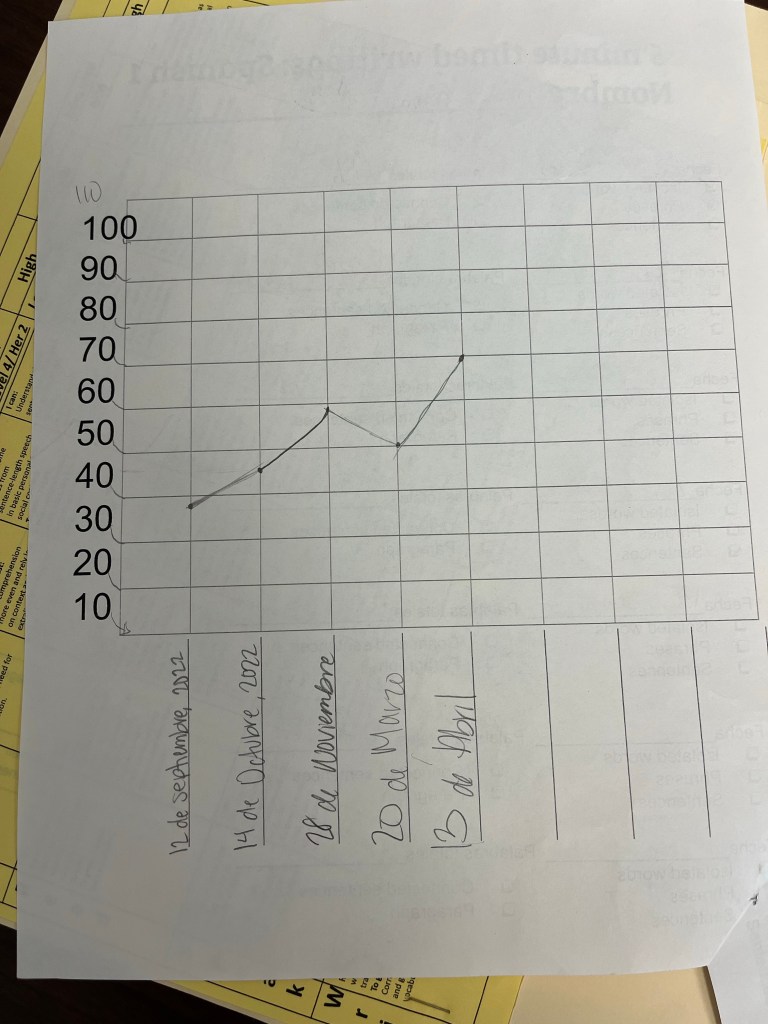
- Then they paperclip their Quick Write to the Data Tracker, slide it into their Portfolio, and we carry on our marry way.
- Repeat again next month! There’s no sense in doing it more often; weighing the pig more often doesn’t make the pig grow faster! (Who said that? Susie Gross? Blaine Ray? Someone said it and it wasn’t me) Remember, it’s input (reading and listening) that makes the pig grow (and by that I mean the brain acquire language).
A word about grading Quick Writes:
Don’t.
If you want more than one word, here’s why I don’t grade them: I hate grading with the white hot intensity of a thousand suns, and my time is much better spent planning engaging lessons. To tell you the truth, I don’t even look at their Quick Writes, because the main goal is to impress them with their growth NOT give me more work to do. They write. They track their data. They marvel on their growth. Then they file them into their portfolios and we move on with our lives. I mean, you could grade them…but why?!
Need a professional Goal? A SLO? Some silly hoop to jump through to prove to someone that you’re teaching them stuff and things?
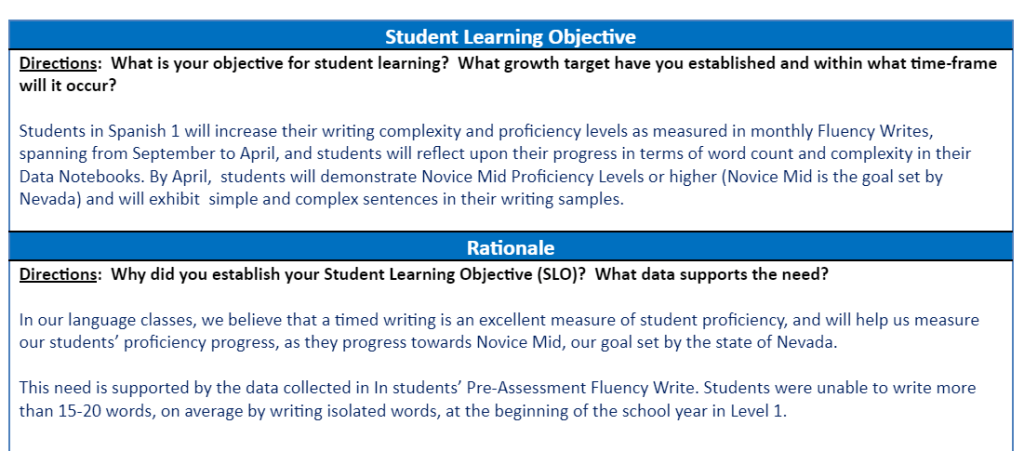
In the Great State of Nevada, teachers have to complete a SLO with student data and multiple assessments and all that jazz as part of our yearly evaluation. If you also have to jump through such hoops, may I suggest using Quick Writes? And to get the ball rolling for you, here’s my exact wording on my district’s exact documents that I submitted last year. What’s better than ChatGPT to complete silly district requirements? Introducing ChatAMC:
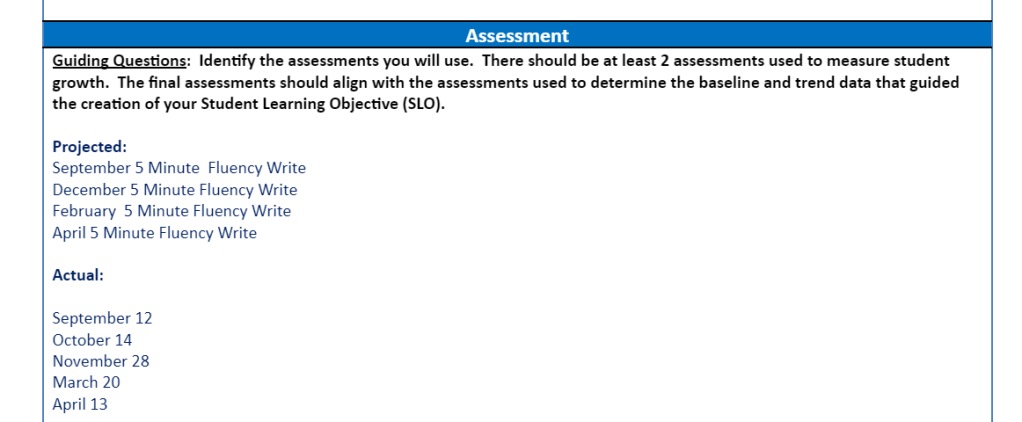
And because boy oh boy, do administrators love data and graphs, right before my SLO was due, I passed out student portfolios and asked them to enter their data into a google form, so it would make accessing the data and graphs easier and prettier than leaving the box of portfolios at my admin’s door. Unfortunately, Google Form changed the way we can copy and share forms, so I can’t just give you a copy of it any more, but here’s what mine looked like:

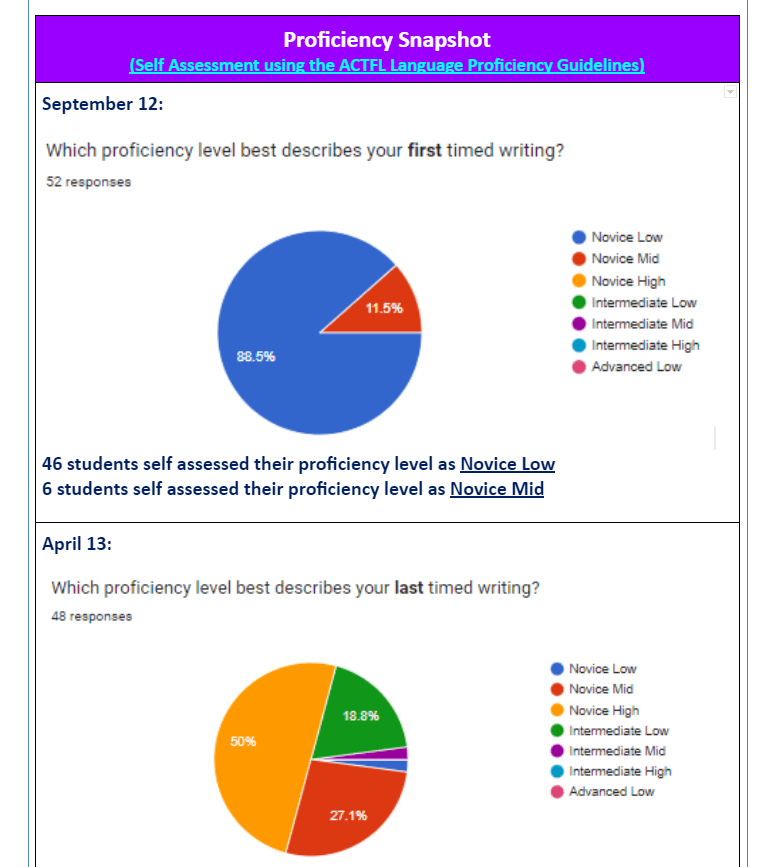
Then I took screenshots from the Google Form responses to analyze my results, for each Quick Write:

Oh wow, look at that! They actually acquired language: their writing is longer and more complex in April than in September! Absolutely shocking, right?! Mrs. Chase is in fact teaching them Spanish!

And their self assessed Proficiency Level increased! Who would have thought that feeding them 8 months of compelling and comprehensible would actually do something in their little brains?! (Except for that one kid, who moved here in March, just ignore that sliver of Novice Low🤣!)
So, if you have to play the game and jump through the hoops, here’s a way to accomplish the goal of keeping your job in a way that (much more importantly) will show students just how much their language has grown and hopefully motivate them to keep on the language journey. Turns out that laughing and chatting in Spanish actually does work! Who would have thought?!
Here’s to a great year, my friends!

 Señora Chase
Thank you very much, I find this a great activity, at least it shows how much language;vocabulary they have learned. Would you do that in every lesson, so it becomes a routine (always good) and they can also compare with previous one
Best regards Isabelle
LikeLike
I only do Quick Writes once a month. They show what they’ve acquired but they don’t add to their acquired language, so I don’t think doing it more often is worth it.
LikeLike
Sra Chase Thank you so much for your quick writes email. I really appreciate that you take the time to share with us. Lisa
LikeLike
I love this! Thank you!
LikeLiked by 1 person
I love your Quick Write form, thank you!
LikeLike
Hi Sra. Chase, it´s Margot here. I´m actually writing about the Quizlet for classroom routines. Thank you so much for that—it worked really well and it was so much better than just reading over the course description.
I´m also using a LOT of what you suggested in your ¨Year in review—what worked/what didn’t/what’s changing”. Even though the school year is still very young, I already feel better about the classroom management policies you’ve helped me to put in place.
I hope you have a wonderful school year and thank you for ALL your good ideas! ~Margot
LikeLike