
For me, preparing students for the Argumentative Essay is the most daunting task of teaching AP Spanish Language and Culture. It’s such a beast because it takes a long time to complete the assignment and even longer to give them feedback and frankly I don’t think writing a bunch of essays and grading a bunch of essays is a good use of our precious time.
Here are 3 things we’ve done this year to “Tame the Beast”…. ways I’m preparing my a Little Darlings to write successful Argumentative Essays, without sacrificing entire class periods to essay writing and hours with a red pen afterwards.
Break it down: The Nuts & Bolts:
I find that my AP Little Darlings need some help before they can jump into the argumentative essay. If your Little Darlings are strong writers, you can probably skip this part. We start with La tesis…what it is and what makes a good one. They practice re-writing bad theses and writing their own in pairs and individually. Then we talk about what makes good intros and strong conclusions. Finally, we touch on the elements of the body paragraphs. For each part of the essay we look at good examples (and sometimes look at bad examples and make them better!) and they’ve got time to try out each portion, with the support of a peer and then individually.
Here’s a little sneak peek:
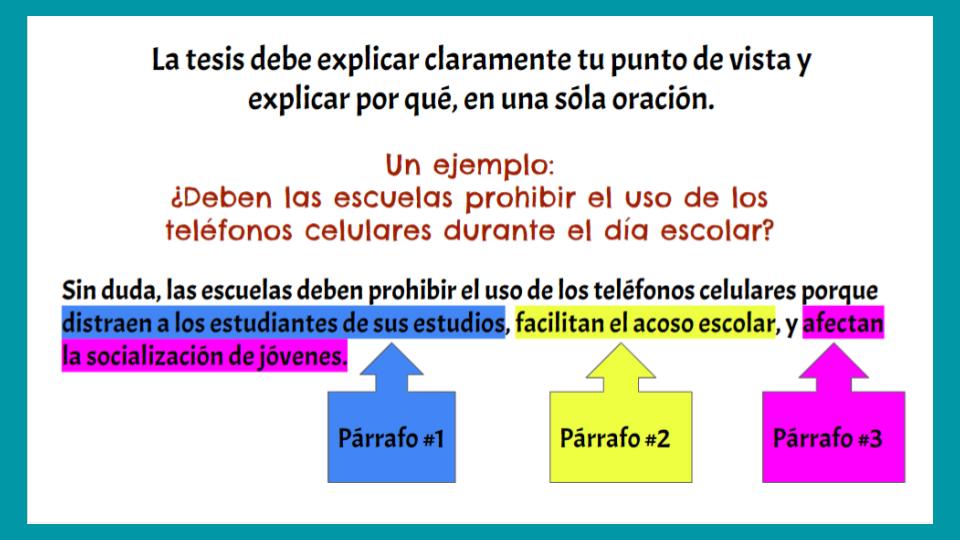
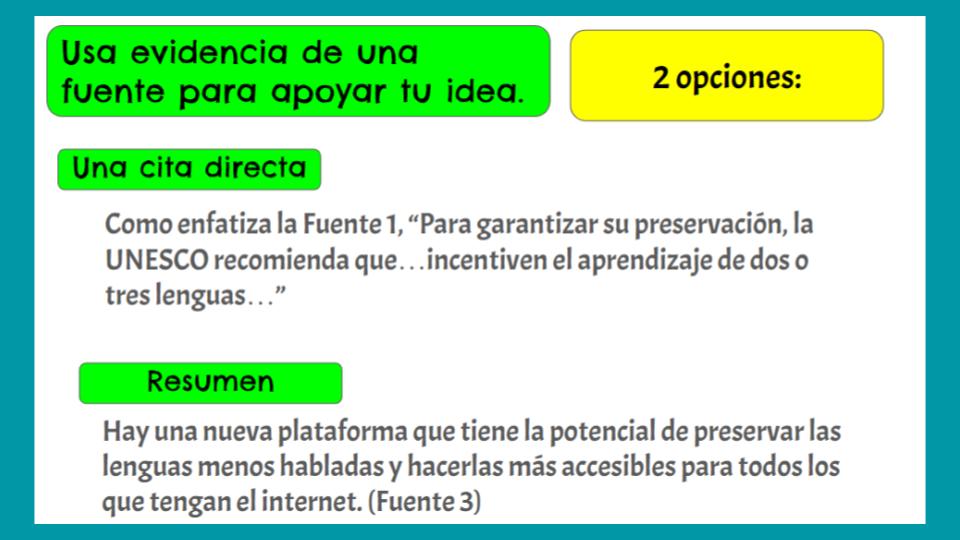

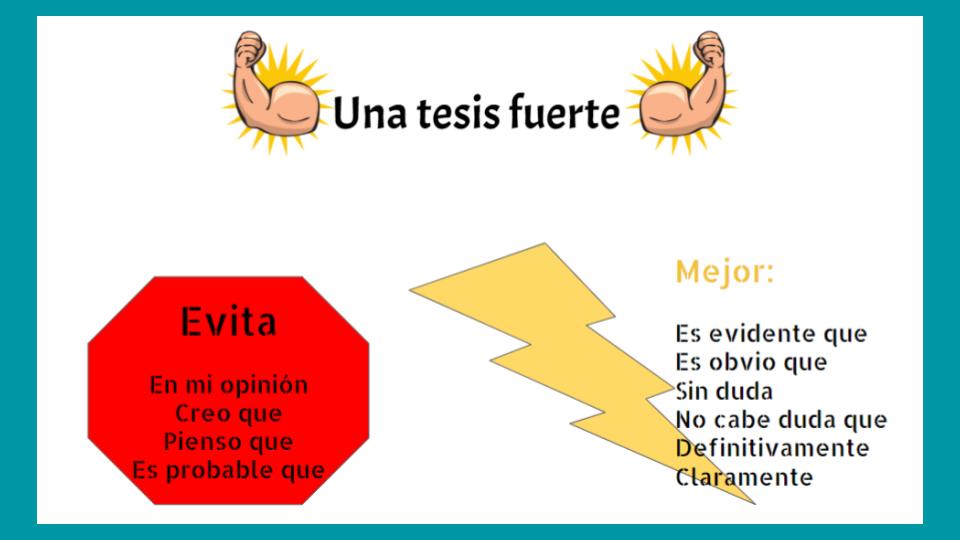
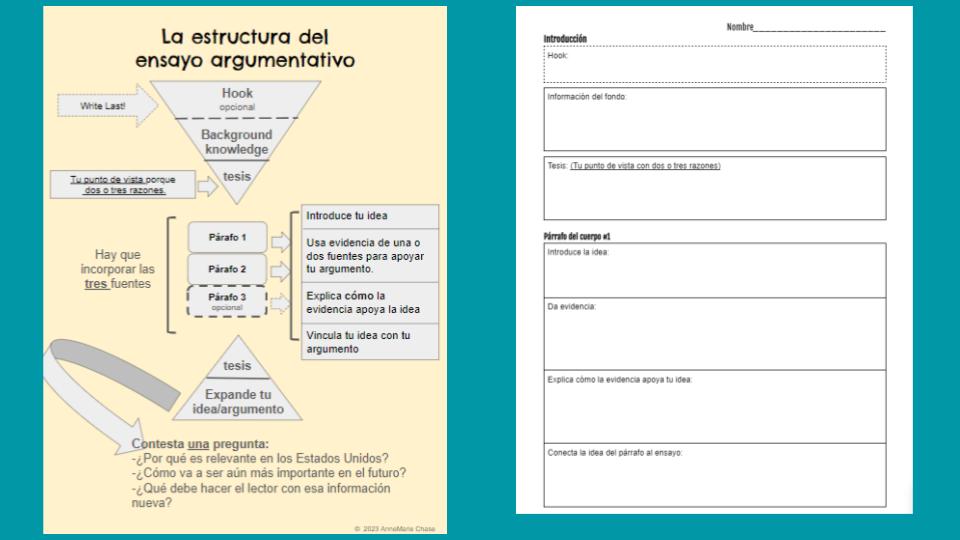
Here are a whole slew of resources I created to teach the parts of the Argumentative Essay. Grab them here for FREE (and pretty please, let me know if you catch any typos or grammar mistakes so I can fix them!)
And if you’re so delighted with these free resources that you want to show some gratitude, I would never say no to a cup of tea 🫖😊
The Claim Game:
Gary DiBianca created The Claim Game to help his upper level students develop arguments supported by evidence, an essential skill in AP Spanish. I made a few modifications to Gary’s brilliant idea to align it a bit more closely with with the AP task, and with Gary’s blessing, here’s how we play in AP Spanish:
To prep before you play:
Choose a practice Argumentative Essay topic and gather the three supporting sources. For this example, I’m using: Lenguas y culturas en peligro de extinción: ¿un resultado inevitable de los avances tecnológicos? from José Díaz’s AP Spanish, preparing for the Language and Culture Examination but you can easily adjust the game for any essay you’d like your students to work with.
Gather the sources and make them available for students. The first time you play, you might want to only give them one source, but work up to playing with all three sources. Also, prepare the slideshow, replacing my claims with your own. Think about some arguments your students may use to respond to the question, and write them in the form of a statement. (Basically, you give them the claim and they have to find the evidence in the sources to support the claim.) For the example above, I wrote these four claims:
- Es importante proteger y mantener las lenguas menos habladas.
- La tecnología ha tenido un impacto negativo con respecto a las lenguas minorías.
- Se puede usar la tecnología para proteger las lenguas en peligro de extinción.
- La educación puede preservar las lenguas minorías.
You’ll notice that together these claims do not create a coherent essay…I purposedly wrote claims for both sides of the argument.
To play in class:
Divide them into teams of 4. Give them the essay topic and the sources. Give them time to read/listen to the sources and brainstorm how they could use the information to support both sides of the argument, before they see any of the claims.
Next, remind them how to take a claim and flesh out an argument. They will do this in four steps:
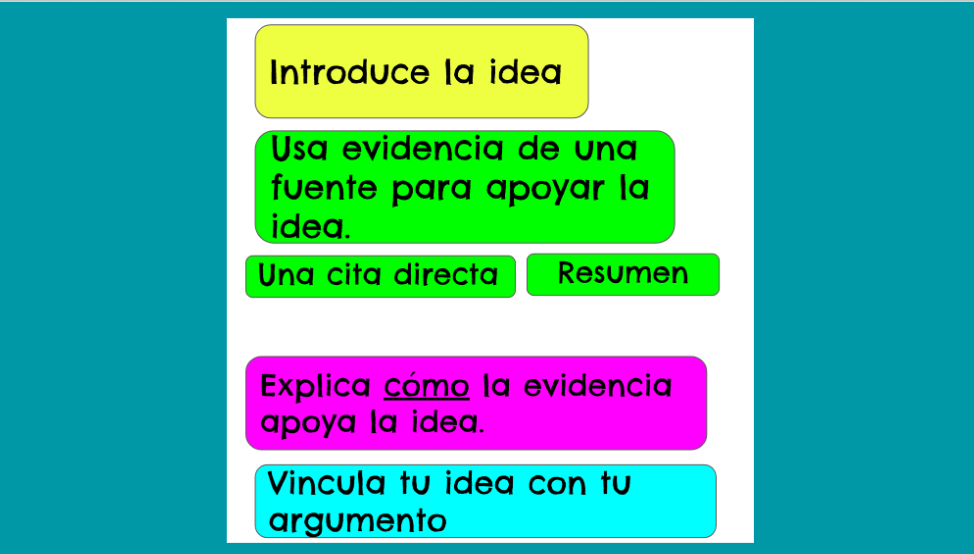
To support my students with more academic vocabulary, I give a few sentence starters for each step:
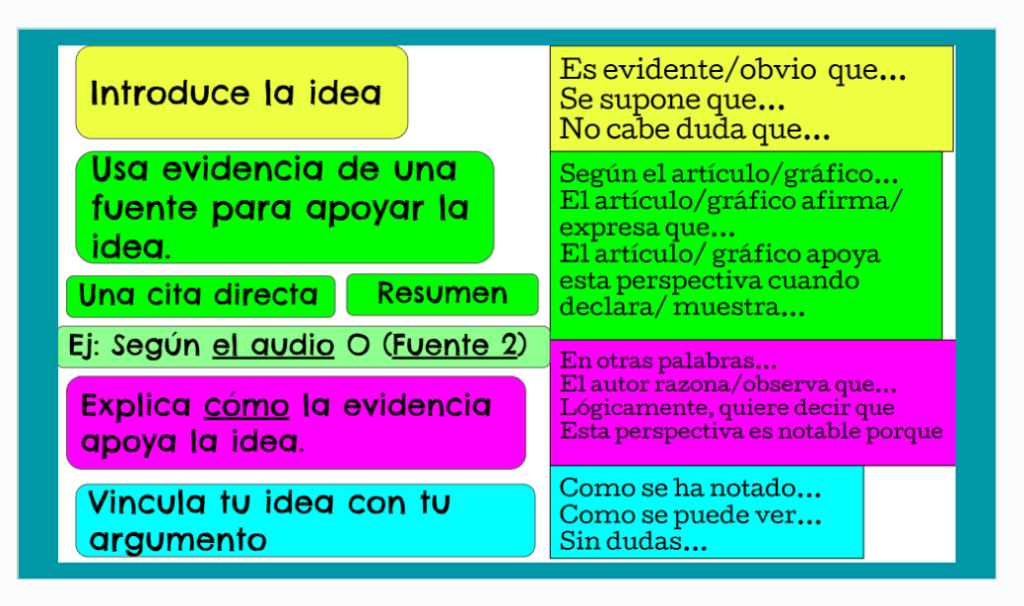
Then we play. The teacher give the entire class class one claim, and working in their team, each student is responsible for addressing one step, by writing one sentence, on a mini whiteboard. (So, Student A would write the sentence to “Introduce la idea”, Student B “Usa evidencia de una fuente para apoyar la idea”, Student C “Explica cómo la evidencia apoya la idea” and Student D wraps it up by bringing it back to the main idea. ) First as a team the talk about the claim and the best evidence to support the claim, then they each write their portion of the argument. Once everyone in the group has written their segment of the argument, they arrange them in order and show them to the teacher. Combined, they’ve written a paragraph, supporting the claim that the teacher provided:

Since it’s a game, there are points:
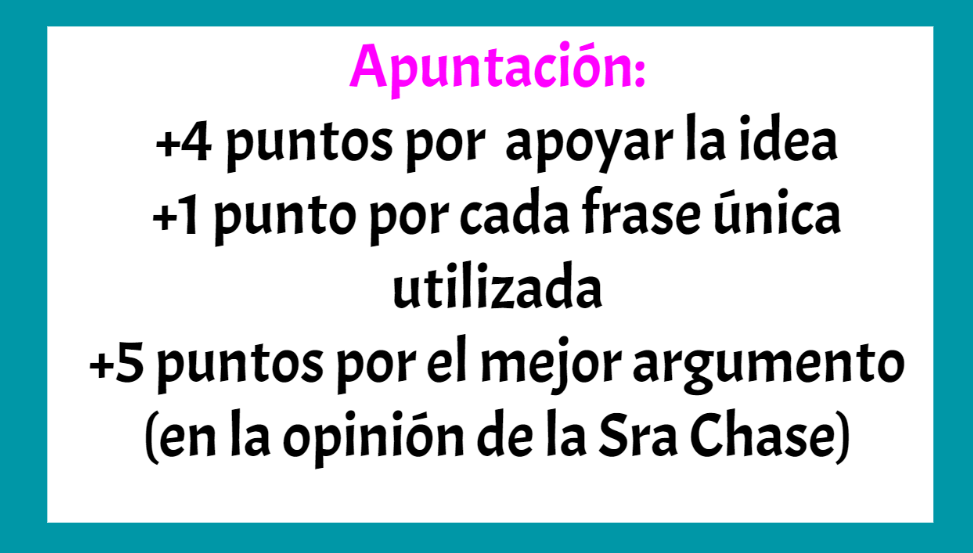
When a group finishes, I award their points by giving them poker chips (I teach in Nevada!) but if that would be frowned upon at your school, give them something else to represent their points.
- Each group gets 4 points, if they’ve followed the structure and supported the idea using evidence from a source.
- They get 1 additional point for each phrase not included in the sentence starters slide. (So, if they used, “Como se puede ver” (which is on the sentence starter slide) cool, but if they use a different transition, they get an additional point.
- Then, after I’ve reviewed all groups’ whiteboards, I award 5 points to my favorite, share it with the entire class and we talk about what made it so awesome.
Then, give them the next claim and everyone gets a new “assignment” for the new claim. (So, Student A who last round introduced the idea now will use evidence to support the claim. Student B who used evidence last round will now explain how the evidence supports this new claim, and so on.
We’ll spend 40-50 minutes playing with about 4 claims. The thing I love about it is that they’re practicing good organized writing, without having to actually write an essay (and there’s nothing to grade after class!) and I really love the way they coach their teammates as they consider the best evidence for the claim. I also love that there’s nothing to take home to grade! Win-Win! Thank you, Gary, you rock!!!
Grab a copy of the slideshow here and edit to include claims for the essay you’re working with.
Peer & Self Scoring:
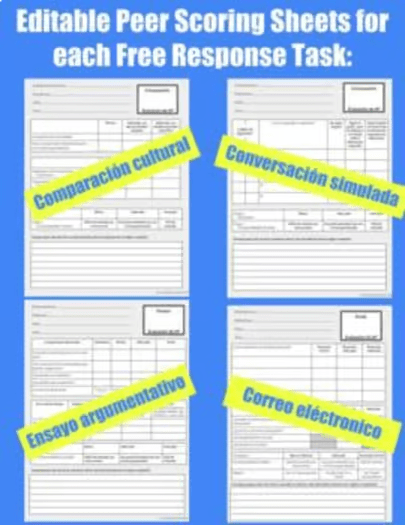
The AP rubrics are pretty dense and in my experience, difficult for my Little Darlings to digest. Here’s my Argumentative Essay Peer Scoring Sheets (free download from TPT!) that breaks down what College Board is looking for in a checklist format. We use these in class in a variety of ways:
- Students use them to self score, after they write an essay. (Or, I love the group essay model, taught to me by Bethanie Drew. In a small group they collaboratively write one essay, then use the scoring sheet to objectively score their work.)
- After everyone’s written an essay, they trade essays and peer score and give feedback.
- We us the scoring sheets to score the sample essays provided by College Board. (I like to do this early in the year, as a way to introduce the Scoring Sheets and the Argumentative Essay task.) After they read the sources, and a sample essay, they complete the scoring sheet to help them predict the actual score that the essay received. To indicate their prediction, I have students move around the room: “Move here if you think this essay scored a 5, here for a 4, here for a 3, and so on…”
- I use them myself when I score their essays! I only actually give feed back and a score on ONE FULL essay, right before spring break so I can use airplane time to grade. This year essays and scoring sheets will be traveling to Michigan with me for the CI Mitten Conference. Will I see you there?!
And if you love the Argumentative Essay Scoring Sheets as much as I do, here’s the whole kit and kaboodle: scoring sheets for all the AP Free Response Tasks.
Wishing you all the best with your Little Darlings and their Argumentative Essays! Hope you found something helpful in here!
❤️, AnneMarie
 Señora Chase
this game sounds genius! Can’t wait to try it. Do you have a time limit per round? I only have 40 min classes but I’m thinking I could use to classes if needed for interpreting the sources and then playing. Thank you for sharing!!
LikeLiked by 1 person