
I had two unique opportunities this summer, to take a few Thai classes during the Fluency Matter’s Conference in Denver, immediately followed by a week of Japanese class at a language school in Sapporo, Japan. The juxtaposition of these two classes, strikingly different in their approach to teaching philosophies, teacher behaviors and student expectations, gave me a lot to think about in terms of my own classroom and the experience that I want to create for my Little Darlings when we head back to school next week.
Class details:
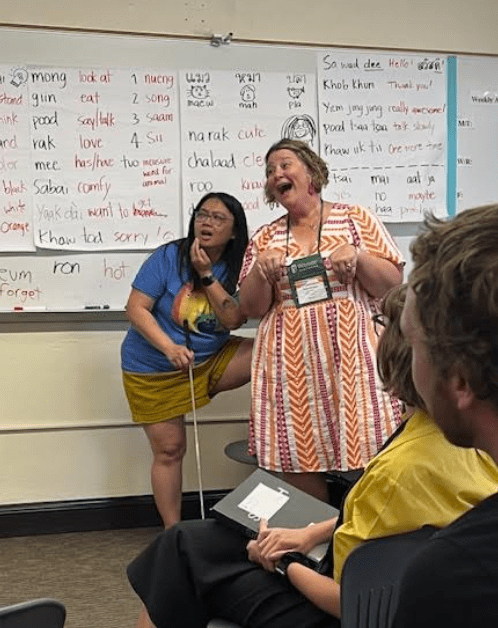
My Thai class, taught by La Sripanawongsa, embodied everything that makes teaching with Comprehensible Input special: laughter, light-heartedness and community. Even though we only spent about 4 hours together total as a class, over the span of 4 days, we acquired an impressive amount of Thai and had fun doing it! All the “students” were language teachers, experiencing a “new” language as if we were novice students.
My Japanese class spanned about 15 hours over 5 days, and there were 8 of us, adults from all over the word, excited to be learning Japanese in Japan. The language school we attended has about 150 students, divided into small classes based on level. I started at the very first level and Señor Chase jumped into an intermediate class because he’s awesome and has been working on his Japanese a lot longer than I have.
The purpose of this post is not to dog on a traditional language program nor to extol the virtues of teaching with Comprehensible Input, but rather to reflect on my experience as a student in both settings as I prepare for my 19th time heading Back to School.
Philosophy:
Thai Class: Since the purpose of offering lesser taught language classes at a teaching conference is for participants to “feel” acquisition from a students’ perspective, our class was taught with the understanding that languages are acquired through a flood of input (listening and reading) that is understood. Everything Teacher La did during class helped make Thai comprehensible and accessible to us. Her speed, gestures, pointing and pausing, quick translations, word wall, all the things we do in our classrooms, was to make La’s messages clear to us. This my friends, is called teaching with comprehensible input.
During class we were encouraged to signal if the messages became unclear and La would respond quickly with a rephase or translation to make sure everyone was on board before moving on. No man left behind in Thai class.
Japanese Class: The Language School put all their eggs in the textbook basket: Minna no Nihongo (which ironically means Japanese for Everyone, but a more apt title might be Japanese but not for AnneMarie). My week started with Lesson 1 and proceeded into Lesson 4 while my husband’s began in Lesson 14 and plodded through to Lesson 16. For both our classes, the teaching philosophy was: memorize all the vocab, do your homework, complete the grammar practice, and repeat after the teacher ad nauseam them move onto the next lesson, and presumably after 50 lessons you’ll be proficient in Japanese or die trying.
I desperately wanted a signal to tell my teacher when I was lost, but after stopping her like 6 times in the first hour of class, I gave up. My next strategy was to whisper to the student next to me, “what is she talking about?” to which he responded, “no clue”, so at least I wasn’t alone in my confusion. Misery loves company, I guess.
Affective Filter:
The affective filter hypothesis is a theory in second language acquisition brought to us by Dr. Krashen that asserts a learner’s emotional state, particularly negative feelings like stress, act as a barrier to language learning, hindering their ability to absorb and process comprehensible input.
Thai Class: It was obvious to this language teacher that one of La’s primary goals was to ensure a positive experience for her students. Stress levels were low and interest was high. We had the tools we needed to participate in the conversation (a few useful expressions written phonetically on the board) but without any pressure to preform or fear of being singled out. Output was celebrated but never required. Our brains were primed to acquire lots of language and boy did we!
Japanese Class: I am not sure that my teachers were familiar with the concept of Affective Filter nor particularly concerned with making the students feel comfortable or safe. The stress was palpable: we had to memorize dialogues to preform in front of the class (😳) and frequently “cold called” for the next answer in textbook exercises. (😖) On the bright side, this did seem to help us acquire the phrases “shirimasen” (I have no knowledge of this) and “wakarimasen” (I don’t understand) so, there’s that.
Classroom Community:
Thai Class: Unsurprisingly, La fostered connections among our class from the very start. When we use the target language to learn about out classmates and celebrate our accomplishments, you can’t help but create a special sense of community. La taught us a fantastic (and cultural) way to encourage each other: an enthusiastic shoulder-shoulder-thumbs up combo while exclaiming “Yiem Jing Jing“, which unified our “team” and brought smiles to all. We learned about our classmates’ pet preferences, talked about Taylor Swift’s cats and made up a cute story about one student’s black dog who missed her while she was in Denver. After just our first hour together, the joy and connections were impossible to ignore and we left Thai class excited to come back!
Japanese Class: It’s odd that I spent waaaaay more time with a muuuuch smaller class and the only thing I could tell you about my Japanese classmates were a few names and nationalities. Instead of learning about each other, we focused on (fictional) Mr. Santos and his wife María from Brazil who are working for a Japanese company and a few other invented characters from our riveting text, Minnasan no Nihongo (Loose translation: Japanese for Everyone, including Mr. Santos and his wife María but not AnneMarie). What a shame and missed opportunity that we spent a whole lot of time dissecting their daily schedules and shopping preferences, instead of getting to know each other. Spoiler: turns out no one cared much about Mr. Santos nor poor María.
Use of English:
Thai Class: Of course using Thai was encouraged and supported with some useful expressions on the board, but there was no hard-and-fast English prohibition. La used English when necessary to clarify instructions or tell us fascinating cultural tidbits like, the number 5 is pronounced “Ha” in Thai, so when texting “55555” is the equivalent of LOL or Ha Ha Ha. (SO FUN!) I didn’t feel shamed for using English when I needed to ask my neighbor for a pencil or whisper a joke or answer a question or whatever. We used a little English here and there and nobody died.
Japanese Class: The school’s rule was “Absolutely No English Ever” which in theory sounds fine but in practice, in my Novice class, proved ridiculously comical. The teacher would give directions. We didn’t understand. The teacher kept giving directions. We still didn’t understand. We asked for help in English. Teacher answered in Japanese. FOR. FIVE. DAYS. The amount of wasted instructional time made this teacher want to jump out the window. Same thing with grammar questions. Ask in English; teacher answered in Japanese. Total confusion. Rinse and repeat. English was prohibited and we tried to be compliant by only whispering to each other when the teacher wasn’t watching. It felt icky for this rule follower who doesn’t have enough language to comply with the rule and shocked me how much banning English raised my affective filter.
Error Correction
Thai Class: As you’d hope in a brand new novice class, La listened to understand and celebrated our every utterance in Thai. It reminded me of parents delighted to hear their little ones beginning to communicate, without even noticing the “language mistakes”. I remember thinking during class, “wow, Thai is really easy and fun.” I am certain that Thai is not “easy” by any means, but isn’t that the most important job of a language teacher, to make everyone feel successful, capable and confident?!
Speaking of confidence, I’ve been to my favorite Thai restaurant twice since I’ve been home, just to inform the owner Kong about Taylor Swift’s cats, in Thai. (Incidentally he wasn’t working both times, but I inquired about his work schedule last night; he’s going to hear about Taylor’s cats in Thai, so help me God.)
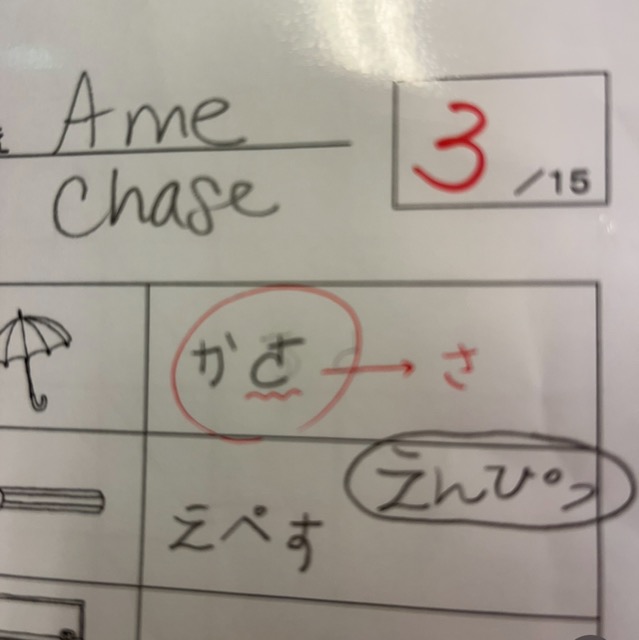
Japanese Class: At this point I should clarify that during my week of class, I had 3 different teachers. My first 2 teachers were kind and encouraging, and even though we had to learn about Mr. Santos, they used a lot of our CI tools. Unfortunately I ended the week with a teacher who’s mission was to correct every mistake as if she were getting paid per correction. Thursday and Friday were miserable because everything anyone said got corrected, and as you can imagine, it didn’t take long for us to just give up. It was so disheartening that my husband and I snuck out during break on Friday morning, skipping the last 2 hours of instruction and our “graduation” ceremony. My lasting impression from class is, “Japanese is too hard. I’m never going to get this.” I still want to cry thinking about my last days of class, it was that bad.
Sooo, it’s probably not shocking that I want my classroom to feel more like Thai than Japanese. I want my Little Darlings to feel empowered, excited and unstoppable. I want them to feel safe to experiment with their brand new Spanish and cared for by their teachers and classmates. I want our classroom to be full of inside jokes and shared experiences that everyone’s in on. I want them to feel like Spanish is easy and they’re super stars with language super powers, ready to take on the world. I want to recognize English use as a tool that will help us get to the place where we can maximize our time in Spanish. I want class to be about them and for them, a place where we use Spanish to learn about each other and the world, because let’s face it: No one cares about Mr. Santos and his wife María.
Be like La. Make your class like Thai. Here’s to a great year! 🎉🍎🎉
Guess which class was more fun?!

One disclaimer: Please don’t think we had an awful time in Japan. We ate everything and visited Sr. Chase’s Japanese family and had the best time(outside of class!), so don’t you worry about us:


 Señora Chase
Hi, Sra. Chase, what a great column! (I’m sorry I didn’t read it until now.) I’m going to keep this to remind myself just what our purpose is as language teachers! Thanks so much for taking the time to write this. ~Margot
LikeLike