Last night I got back late from the Fluency Matters Conference in St. Petersburg, Florida and this morning I’m up early, excited to share what I’ve learned while I’m still riding the conference high.
It was a marvelous few days spending time with dear friends, meeting loads of new ones and soaking a zillion ideas and some masterful teaching. My highlight, without a doubt, was taking German with Justin Slocum Bailey. Over the course of 3 days, I participated as a student in 4.5 hours of German, of course, taught by loading up the Little Darlings (me and other conference participants) with loads of comprehensible German. Besides acquiring an impressive bit of German in such a short amount of time (more on that below!) I gleaned lots of insight into what it feels like to start learning a new language and lots of tricks I am excited to weave into my own practice with my own Little Darlings in The Chase Place this upcoming year.
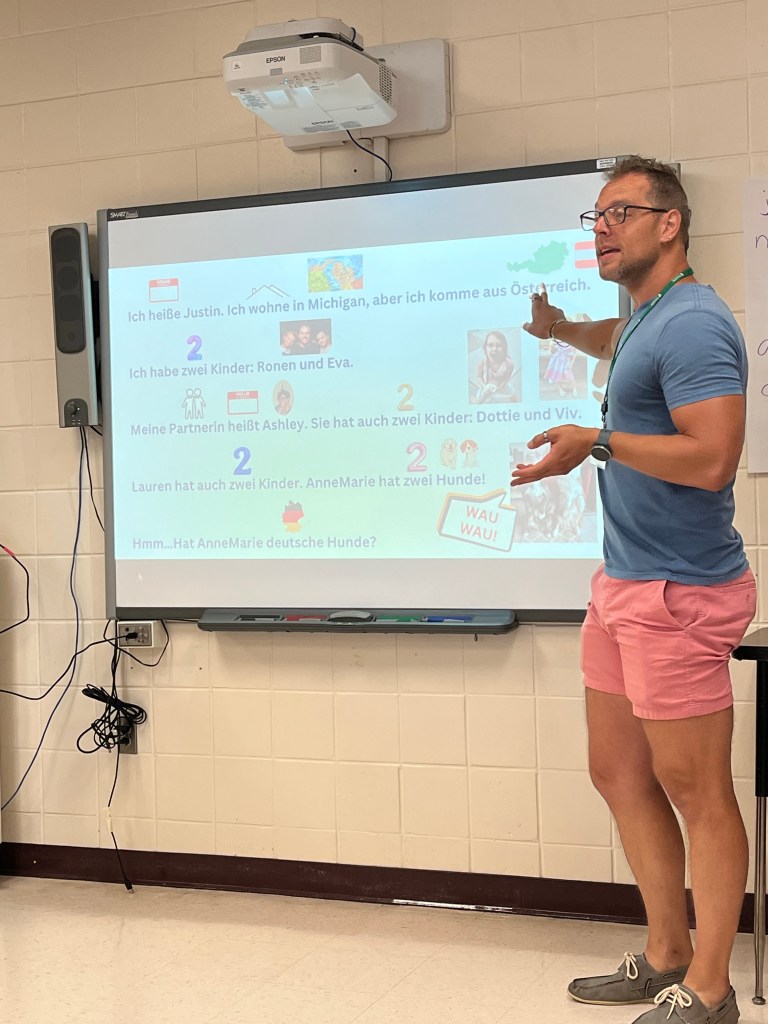
And without further ado, here’s what I learned (and acquired!) from Justin:
Go slow to go far:
Being a student in Justin’s class was so relaxing! (No one has ever said that about my teaching.) He chatted with us like he had all the time in the world. (The OPPOSITE of “I only have 4.5 hours, which is only 270 minutes which is ONLY 16,200 seconds SO BUCKLE UP AND LET’S GET MOVING!! NOT A MOMENT TO WASTE BECAUSE I HAVE LOADS OF GERMAN TO TEACH YOU!”. So unlike how I teach; I’m afraid my teaching feels more like mix between an overly enthusiastic jazzercise instructor and a Drill Sergeant.)
He chatted with us, made us laugh, told jokes, played games and nothing felt frantic or rushed. His attention was directed to us, not the clock or his plan. And yet…without any rushing or cramming or scribbling notes or studying, I left the final class awed by how much German I had just soaked up without even trying. That is the power of teaching with Comprehensible Input, my friends!
So, this year, I want to keep this in mind: Go slow to go far…and I’m not just talking about rate of speech. I want to prioritize chatting with my Little Darlings and fostering connections among them, without glancing at the clock and thinking about my next transition. I want to channel more Justin Slocum Bailey Zen and less Jazzercise Drill Sergeant. He worked magic in just four and a half hours…we’ve got plenty of time!
Backwards planning:
Confession: I know Backwards Planning is a thing you’re supposed to do (You know, before you start a unit, you think about the final assessment and what the students will do, and then you ‘backwards plan’ to give them the skills/vocab/grammar they’ll need.) It sounds like a great idea. I just don’t do it. Mostly I follow my heart then after about 6 weeks I’m like, “dang, I better give them a test so it looks like these tax payers are paying me for a reason”. Let me be clear, this is not the preferred method AND I’m not recommending it…it’s just what’s worked out pretty well for me over the years. And to be perfectly honest, I never really felt the need to change. Old dog, new tricks and all that.
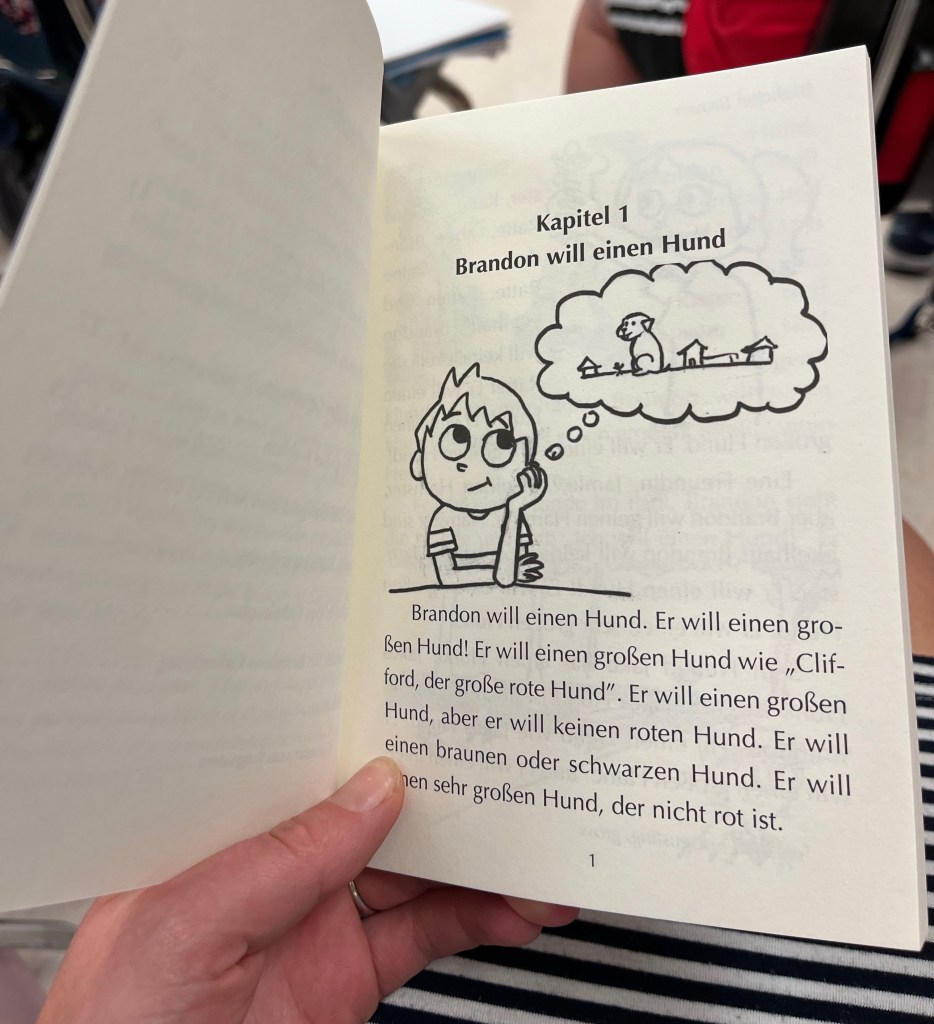
Justin changed my mind. He was so sneaky with his backwards planning that we were totally unaware! While he was all laissez-faire chatting us up like he didn’t have a care in the world, every conversation was carefully crafted to give us the puzzle pieces we’d need for our final “assessment”. During the 3rd and final lesson, he pulled out the novel Brandon Brown will einen Hund and he read us the first two pages in German AND WE UNDERSTOOD IT!! And I don’t mean just the main idea or the gist or he had to give us a bunch of extra translations as we read it together. As he read and we chorally translated into English and it clicked: the conversations, games and brain breaks were not random at all…everything were carefully orchestrated and executed so that we’d be able to read about Brandon Brown and his desire for a Hund. Justin knew where he was taking us and planned from there. NOW I’M A BELIEVER. This old Hund is going to try some new tricks.
Reading and writing are motivators:
I’ve believed for a long time that reading is critically important for language acquisition and that’s why we do lots of it in my class…what I didn’t realize is that reading is a motivator as well! I was on top of the world while we were reading because it made my language gains tangible. We can’t see the language that’s in our heads, but we can hold it in a book and see all the words we know, and wow, does that feel good! (Full disclosure: I finished reading the chapter online and I only had to look up 4 new words and even though I’m practically a fluent German speaker now, I need more German! Susie Gross (my first CI trainer) was was right: “Nothing motivates like success”. Amen, sister!
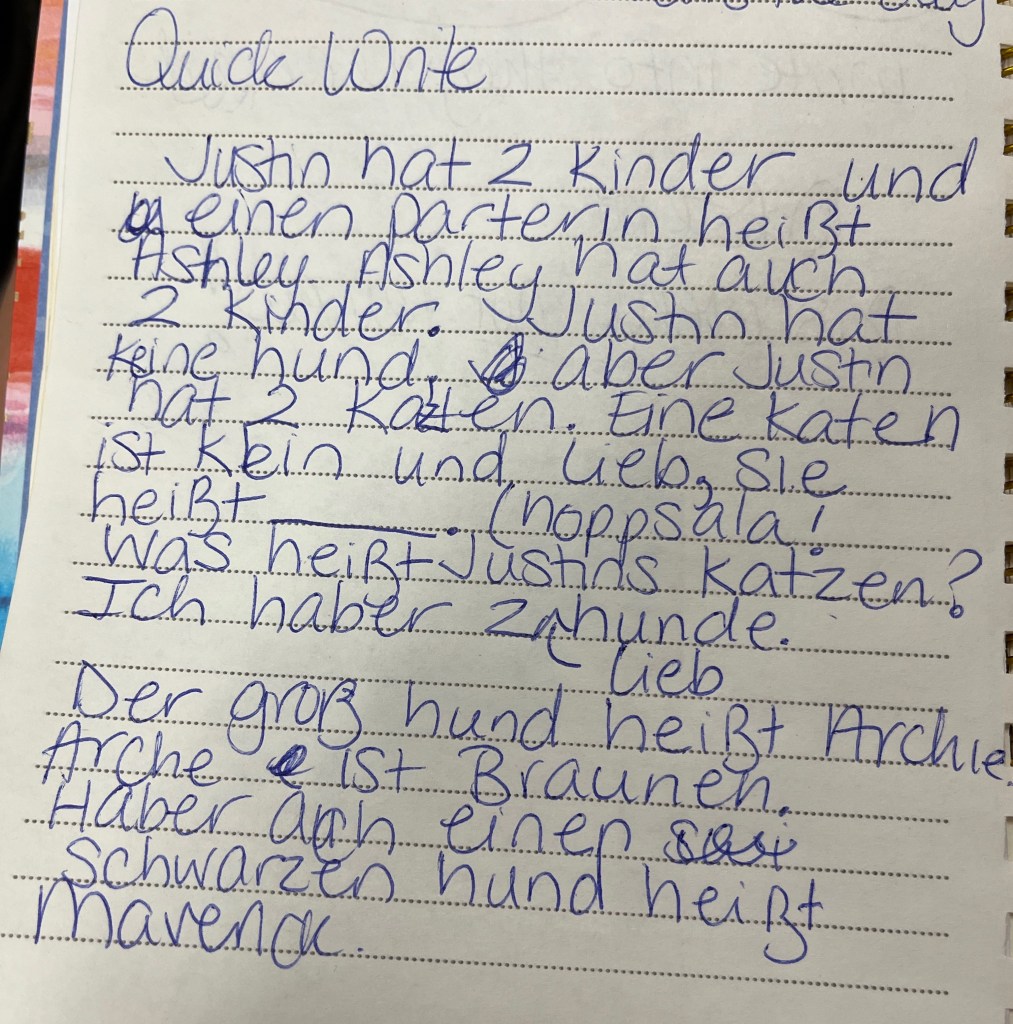
AND THEN WE DID A QUICK WRITE AND HOLY MOLY! Everyone wrote for 4 minutes and I was shocked!! I wanted to write about what I learned about Justin and could express what I wanted to say!
Is it clean? NEIN!
Loads of mistakes? JA!
Do I feel awesome about my German? SUPER JA!!!!
In my classes we do plenty of quick writes and loads of reading, but this year I want to maximize their motivational value. I really want to make it explicit: “all this language on the page (printed, published or their own writing) is a measure of what’s happening in your brains and worth celebrating. We can’t count the words you’ve acquired or measure everything you can do in Spanish, but here’s a little peek. Can you believe it? I am so proud of you!”
A few more observations and their application in The Chase Place:
Trying out new words: In CI circles we don’t ask students to repeat words, and some teachers even discourage it…but during our classes, almost every time a new word was introduced, I noticed that we couldn’t help but try it out. Maybe it’s because German words are so fun to say. Maybe it’s because it’s a low stakes way we can be in the game. Maybe because by saying it out loud, we are trying to make it our own. There’s something about trying on a new word and feeling it in your mouth. I’m going to lean in, “This one is so fun to say, try it!” If nothing else, it’s just another engagement strategy to draw their wandering attention back to our mission.
“Do you think Katze means race car or cat?” Justin did quite a few of these comprehension checks, giving us an obviously wrong answer and the right answer to make sure we were tracking with him. I thought it was hilarious and it is an easy and safe confidence booster for my not so confident Little Darlings. This new trick is going into my tool box.
Building vocab lists as we go: As we progressed though our lessons, Justin added words to a few large papers on the wall, one dedicated to “function words” (words like and, but, or), another for fun expressions to holler out (like Oopsies! Hurray! Aargh!) and a third list of additional bonus words…ones that came up but were not targeted with lots of repetitions. These lists were indispensable when it came to Quick Write time, and without them I would have felt frustrated and unable to say what I wanted to say. They were a powerful tool and even more so because we “built” them together…they started out as blank papers and by the end of our third class, they were “our” personalized word list.
I love it and I want to figure it out…but how to recreate that times 4 Spanish 1 classes with limited wall space?! I’m working out a plan that includes large papers, skirt hangers, a dedicated spot for classroom viewing, and a storage spot to hang them after class (on skirt hangers), and the classroom job of setting up and putting away our “class’s lists” each period. I’m still working out the details, but once I get it ironed out, I’ll share. Finally, as we wrap up a unit/story or whatever, I plan to compile the words into a document (organized by essential words / function words / fun expressions and bonus words) for them to keep in their binders. (Just kidding…my TA will do it, I do not have time for extra work 🙂 When we begin a new unit or story, we’ll start again with fresh wall papers, but they’ll have their previous “vocab lists” accessible in their binders. And my lovely TA who can manage all the things will add the new words each day to a dedicated Quizlet list, so absent students or parents who insist that their kiddos “study” can access it from home, and by the end of the year we’ll have one gigantic list and we’ll be able to marvel at how much Spanish they’ve gained this year!
Did you notice anything about the language?: It might be because we language teachers are language nerds, but I loved that Justin gave us a minute or two at the end of each class to share with a partner or the whole class our language observations. In German you capitalize all the nouns! Add an “s” but no apostrophe for possession! Adjectives go in front of the nouns! It made me feel smart and I like feeling smart! My Little Darlings will definitely be asked to share their language noticing and I believe it will encourage curiosity and comparisons between their L1 and Spanish. Hello ACTFL Standard 4.1!
Oh dear friends, I hope and pray that you get the opportunity to be a student in a CI class to dip your toes into an unfamiliar language and feel success! It’s such a powerful learning experience! Next summer the Fluency Matters conference will be in Denver and CI Summit will be in Philadelphia, not to mention loads of online conferences like Conference in the Cloud and CI Reboot, so my fingers are crossed that one will work out for you and you’ll get to experience the magic for yourself!!
Danke Justin for making your language classes such a fun and safe place to acquire! You inspire us to do the same for our Little Darlings!


Anne Marie, thanks for summarizing the wonderful things we learned in Deutsch mit Justin! I believe my take-outs are the same, but you organized them so well! I felt the same: he went really slow, he stopped to go around our responses, including them in the class and making us feel heard and a part of the process. I also learned a lot during your presentation on the last day (my toolbox is brimming at the moment). Be well.
LikeLiked by 1 person
Hello Anne Marie, wonderful to see you recently. Justin is a wonderful person and teacher! JSB’s Tuned-in Teacher Mantras from 2020 (on his YT channel) helped me stay on track, and I have utilized his mantra “Be the calmest person in the room” many times including most recently at the airport! https://youtu.be/uNnR2fa45nM
LikeLiked by 1 person
Hola, mi querida AnneMarie…
Thank you for this fabulous post! I will be using these new tricks too with my German classes. It was also so lovely to “hear” from you in this post as just one year ago we were hanging with our she-homies in a wonderful jungle far, far, away. I can hear your excitement and vim and verve… I am so similar in the classroom so I will try to channel my inner… “If you want to capture someone’s attention…whisper! (I will talk, but reel them in !)
Miss you much- Suzanne
LikeLiked by 1 person
Thank you so much for summarizing your learnings from the conference. While I have long wanted to travel and attend an in-person experience like this, having 2 kids in college means my money is otherwise occupied! Over the past several years, both you and JSB have been key teachers in my journey toward acquisition-driven instruction, so this post was like a heads-exploding mash-up of two of my favorite educators in one place! I’m going to think hard about your reflection about backwards planning – I used to be a total disciple to this, but my teaching lacked relevance and joy. As my classroom has been transformed (and students are acquiring more Spanish), it has been easy to be dismissive of “old school planning”…but your post makes me wonder about the power of combining the two. ¡Gracias!
LikeLiked by 1 person
I went to that conference last year and learned Russian with Michele Whaley. Being a student again was truly the best thing ever. Thanks for the reminders.
LikeLike
Isn’t Michele the BEST!?
LikeLike
I appreciate reading about these insights as a German teacher – especially your part about pronouncing words. I LOVE having students pronounce the new German words and was concerned that it was somewhat discouraged in ADI since you are supposed to give students a “silent period”. My students always seems to have fun trying out the pronunciation – especially of the long and funny sounding words, so I will keep including that in my lessons. I also SO appreciated having you as my afternoon session leader in St. Petersburg and learned a ton from you. Thanks!
LikeLiked by 1 person
Kristen! It was so wonderful to meet you and I really appreciated the insights you shared with our cohort. YES!! German words are so fun to say!!!
One tip I learned from Justin, that he told us comes from a particular language method but I forgot the name, that works really well with long and fun German words, teach the pronunciation from the last syllable, then combine the second to last with the last, then add in the previous syllable and so on, building the word from the back. Try it and let me know what you think!
Take care and Happy Back to School!!
LikeLike
[…] “Palabras prácticas” and “Palabras divertidas”, inspired by Justin Slocum Bailey’s German Class I took in Flordia years […]
LikeLike