
At last week’s Fluency Matter’s Conference I had the opportunity to watch my dear friend Rita Barrett, author of Libertad, present “Tea Parties”, a super fun pre-reading activity to build interest and knowledge before they start reading a new novel. I’ve got a Gran Hotel themed Tea Party to for you, but first, here’s Rita sharing Tea Parties with you! (And if you think this sounds fun, but don’t want to create one yourself, Libertad’s Teacher’s Guide has one ready to go!)
Take it away, Rita!
Want your students to be eager to read a novel, excited to learn about a historical event or feel familiar with the characters of a telenovela even before they read the first page or watch the first episode? Invite them to a tea party!
A “Tea Party” is a chance for students to “meet” characters from a book, historical event or other story and to make a personal connection with the story. It encourages curiosity and builds interest in the story, as questions will be raised that can only be answered by reading the book. You can also front-load information about the story, cultural practices or historical events. Even though students are speaking to each other during the “Tea Party”, it is input-rich, as they read from scripts, and even lower proficiency students can participate fully.
The Tea Party was originally developed by an elementary teacher at the Santa Barbara Writing Project, and has been used in the English language arts world for decades. I was introduced to the activity as a participant in a mixer, a variation on the original tea party, when Linda Christensen of the Oregon Writing Project presented it to my school district years ago. The topic was the Tulsa race massacre. We were each given a slip of paper with a first-person response to the massacre and milled around the meeting hall, assuming the role of our characters. As we met one other, we began to piece together the tragedy that unfolded in the spring of 1921. Despite my history minor, I knew nothing about the massacre and was intrigued to learn more when Linda shared her historical presentation with us following the mixer. In recent years as the Tulsa massacre has received more attention, I remembered the Tea Party with Linda as a “hook” to hang the new information on.
The teachers from my school went away inspired by the activity and talked about using it in our classes, but as far as I know, no one did. Preparing one seemed complicated and intimidating. Then my Spanish teacher friend Michelle Nicola and I collaborated on a unit to teach Carol Gaab’s novel Esperanza and Michelle prepared a Tea Party! I discovered it was actually pretty simple to use the activity with my students.
Since then, I have adapted the Tea Party to maximize engagement and provide the scaffolding language students need to get the most from the experience–even my lower proficiency students! Let me walk you through it, so you can use a Tea Party to launch your next unit, book or video and not be the “Tea Party wannabe” that I was for so many years! Here’s how to set up your own Tea Party:
First, choose a story:
- The story should be unknown to students — this is discovery, not review.
- A story with some kind of conflict or mystery creates more interest.
- Some of the characters should have some kind of relationship (family, friend, enemy, co-worker, neighbor, etc.), but it is not necessary or likely that all are connected.
Write the character scripts:
- Limit the number of characters so that students will be likely to bump into the most important people in the story. Eight to twelve characters is plenty, so you will have duplicate characters, unless your classes are that small. Keep in mind that your students will probably only meet five or six of them. (Alternatively you could have only 5-6 characters and ask students to meet all of them.) Choose characters who have a prominent role, if possible.
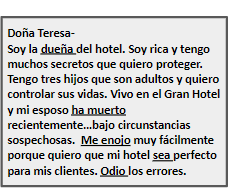
- Write scripts in the first person in the target language. Keep it comprehensible — limit new vocabulary and pre-teach vocabulary if there are absolutely necessary new words. Your students need to understand their own script and also understand the scripts that classmates will share with them.
- Keep the script short enough to almost memorize — perhaps 4-8 simple sentences.
- Give hints of the story, but don’t give it all away. Give little glimpses of connections (if they exist) without making them totally obvious.
Throw the party:
- Make a copy of my Interview Notes sheet for each student. My linked sample is in English, but feel free to change it into your target language.
- You can serve refreshments, which students will love, but it can slow down student interactions and isn’t necessary.
- You may need accountability for staying in the target language (for example, give each student two clothespins, which can be confiscated by other students for speaking L1).
- They should share their information as a conversation. Don’t let them copy from each other’s papers!
- Plan for at least one full class period. Even in my block periods, I don’t try to do anything else.
- Introduce the Tea Party to your students. Distribute character scripts and interview note taking sheets. I show the following slide (in Spanish) to help students understand the activity:

- Give them time to study their scripts and to write the most important information on their interview notes sheet.

- Explain the ground rules. Here’s a slideshow with the instructions in English and Spanish.

- Give students 15-20 minutes to introduce themselves and converse with each other, in the TL. I project a conversation slide in Spanish to help them think of things to say. Students write the most important information on their Interview Notes sheet, making note of anything they discover about their own characters, as well. While students chat, I eavesdrop and give help as needed. If students are not catching onto a connection between the characters, I point it out. (“Is he your dad?”) Or if you want to, you can also take one of the character roles! This slideshow has the conversation support in English and Spanish.

- Call time up as soon as you see that most students have chatted with about five people. Have them sit down and create a web of relationships. They can write names to the side for characters they don’t think are connected.

Extend the Party:
If you have time, there is so much more you can do!
- After students have completed interviews and drawn their webs, discuss the characters.
- Use sentence scaffolds to make predictions about what will happen. I include this on my Interview Notes sheets.
- Write & Discuss
- Game: Who said (or would say) it?
- Look back at interview notes and predictions after students begin to read the book.
- When reading, ask questions about things they learned during the Tea Party.
How do I assess this? I don’t. Personally, I don’t want anything to detract from the pure fun of this activity. My students enjoy the Tea Party and I haven’t yet had to enforce participation. Here’s hoping it stays that way!
A Tea Party is fun, active and engaging. Don’t be a Tea Party wannabe! Try it! Once you have done it once, you will see why my students and I love it!
Thanks a million, Rita! I am so excited to introduce my Little Darlings to Tea Party in a few weeks! ¡Vales mil!
 Señora Chase
This looks like such fun! Thank you for sharing with such detail and resources. I have decided to rename it Kaffeeklatsch to work in a German tradition (even though in Northern Germany tea reigns supreme!). The classmates with whom they will speak are the Kaffeeklatsch Komplizen (accomplices)! I love a good alliteration in any language!
LikeLike
I LOVE IT!!!
LikeLike
[…] has shared this amazing Tea Party pre-reading strategy! It would be a lot of prep- but well worth […]
LikeLiked by 1 person
This is genius! Love it, and I will be using it with some of my whole class novels this year! Thanks for sharing Rita and Anne Marie!
LikeLiked by 1 person