
Every year I wrap up the year, reflecting and planning for next year. It must be the eternal optimist in me, I always end the year believing that the next one will be even better. At the beginning of the summer, I published a “Year in Review” about my general Spanish classes and policies that will be changing next year…but I have a number of AP specific ideas for improvement, so they get their own post.
Disclaimer: I just finished my 2nd year teaching AP Spanish Language and Culture. I am by no means an expert…I’m just figuring this out as I go, trying a bunch of things to see what sticks, and trying something else when it fails. For a giant list of AP Strategies and Resources that I’ve been pleased with, check out this blog post and this one too!
And in the time between I started this post (waaaay back in June!) and finished this post, I’ve gotten this year’s AP Scores back, and let me tell you, they are not as good as they were last year. Last year every single Little Darling passed, with the majority earning 4s. Unfortunately, this year 3 of my Little Darlings earned (well deserved) 2s…so my 100% pass rate is shot. However, I am happy to report that 100% of the Little Darlings who worked hard this year passed, and I am delighted about that! And this year’s Instructional Score Report gave me plenty to think about. So let’s dig in:
What worked:
Practice runs: One of the best things we did this year was practice in the location they would take their actual test. This might not be a possibility for some, but I asked our librarian and she made it happen. Together we strategized the best way to set up seating for minimal distractions and played around with the speakers for best sound. This was not only super helpful for my Little Darlings who got a taste of what “the real test” would feel like, it also helped familiarize our librarian with the flow of the exam, who would proctor the exam on The Big Day.
This past year they took a full length practice exam in January as their 1st semester final, broken up over 3 block class periods, then again at the end of April as their 2nd semester final. In April we tested over 2 class periods. Finally I told them that they would need to take one full length exam in one sitting and that they could take it on their own during Spring Break or come one afternoon after school to take their final practice exam. I wasn’t planning on grading this last exam and I didn’t offer extra credit this year. I just told them they had to do it, and shockingly no one called my bluff 😂 and everyone did it.
After their April Final, they played around with this AP Score Calculator and completed this Goal Sheet, to get an idea of how they would have done on a real test and make their personalized “Homework Plan”. (More on that below!)
Choose your own adventure: My school is big in “Voice and Choice” so in the last few weeks before the exam, I wanted to give them time, inside and outside of class, to focus their efforts on the skills/tasks that challenged them the most. Their “homework” (that I don’t assess or give points for) was to decide what they needed to practice and do it at home.
For their “Homework Plan” I loaded a bunch of practices from My AP Classroom onto Google Classroom. I didn’t verify to see if they did it or give them feedback…I made it available to them and hoped that some would take advantage of it. Did they? Some did.
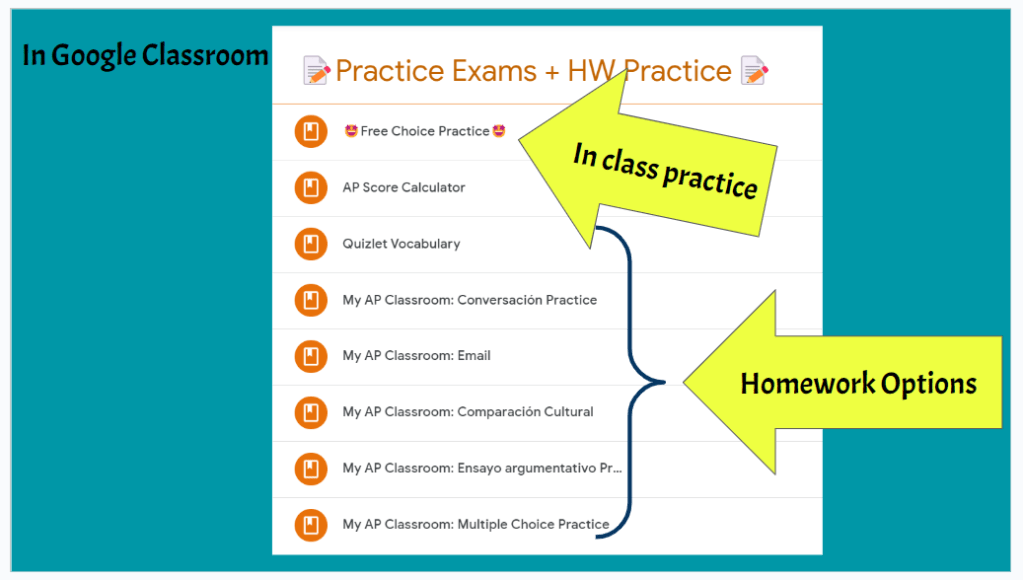
For the two weeks leading up to the exam, I split the class period into two 45 minute chunks. For the first half of class, we wrapped up our final AP Theme and I taught as normal. For the second half, students either worked on “Free Choice Practice” or joined my small group for focused mini lessons- we outlined a new essay together, we practiced citing sources and developing an argument, we brainstormed things to say during the conversation when you don’t know what to say. For the most part I let them decide what to work on…but there were a few times when some particular Little Darlings got special invitations to join my group.
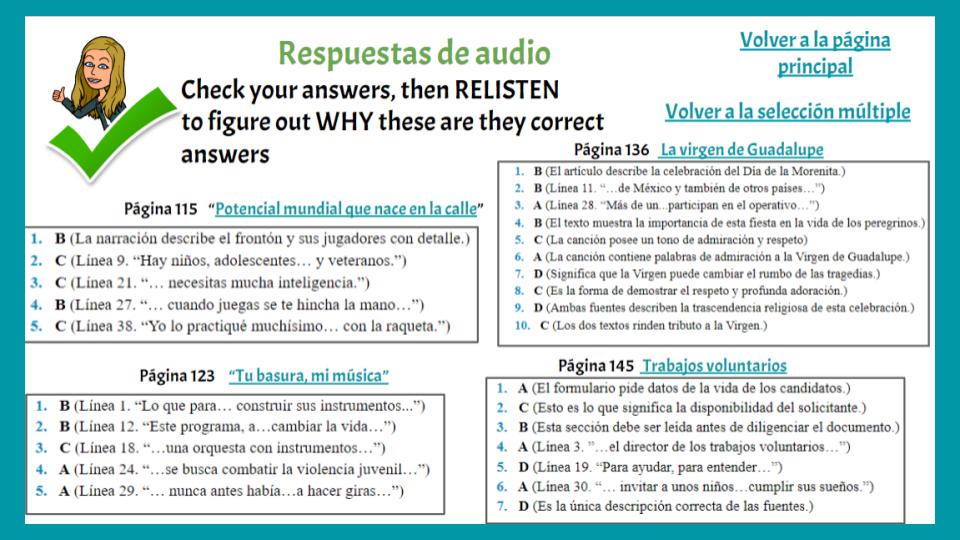
I made a Free Choice Practice slideshow, with a zillion links. As much as I love sharing with you all, I can’t share this one because there’s loads of copywrited material straight out of my textbook. I gave them everything they needed to work independently: practice exercises, audio links, the answers with explanations, worksheets for self-scoring or peer scoring the free response tasks. I loved it that everyone has something meaningful to work on and I had time to work with small groups and conference with individual students. Win-Win!


Focused grading: You probably won’t meet a teacher who hates grading more than I do. I loathe it. I’ve heard lots of teachers say the secret to teaching AP is to give them plenty of feedback, but I just can’t bring myself to spend hours reading and commenting on their essays and watching their dang Flipgrid videos. To make this monumental task manageable so I won’t scratch my eyes out and quit, we often do “Focused Grading”. I pass out the highlighters and ask them to look for one thing to highlight…that one thing is what I’ll read, grade and give feedback on:
- Highlight your thesis.
- Highlight your 3 sources in 3 different colors.
- In your email, highlight your answer to a specific question
- And so on…
Then I’ll ask them to self-score or peer-score the rest of their writing (or speaking) using my Scoring Sheets (more on those below!).
AP Peer Edit Scoring Sheets: I’ve written about these before and I still believe these are the best thing I’ve created in my life. We use these for self-scoring and peer-scoring. We use these when we look at AP scored samples and work through how the student earned that score. I use these when I score their work. My kiddos reported that these sheets really helped understand what they need to do for each task. Here’s a free download for the Essay Scoring Sheet and here’s the whole kit and kaboodle with the scoring sheets for all the free response tasks.

What sorta worked but needs some adjusting:
Passwords at the door: My Little Darlings reported that they felt most prepared for the Email task on their exam. I don’t think it’s because we practiced it any more than any others, but rather, we started off the year strong with some email specific passwords that they HAD to include in their emails. To the uninitiated, “Passwords” are phrases you teach your students, that they must recite on their way into class, as if it were the password to get into a secret club. This year they nailed these “passwords” and consistently used them in their email practices:
- He recibido su mensaje y se lo agradezco.
- Si me permite, tengo algunas preguntas con respecto a su organización/ petición/ encuesta.
- Si Usted requirere información adicional, no dude en contactarse conmigo.
I think they felt less prepared for the other tests because they didn’t have a handful of “canned” expressions to get them started. Next year, I’ll make a concerted effort to teach task specific passwords each quarter that I’d like them to include in their writing and speaking tasks, so they’ll have a nice little collection by the test date.
Here’s my password brainstorm document and I would LOVE to hear your password suggestions that would be useful on their exams!
Another password observation: the Little Darlings who arrived on time got lots of practice with our passwords. Of course the Little Darlings who arrived late every class got zero password practice.
New Policy: If you’re on time, you say the password on your way into class. If you arrive late, you have to give me the password before you leave class. We’ll see how it goes!
What didn’t work:
We learned about LOADS of culture this past year, but we didn’t have a good way to organize the learning to make it accessible. Although we had talked and read and watched and made a zillion culture comparisons, it was hard for them to go back and review all we’ve learned before the test. What we need is a system that’s easy for them to go back to, so that every time they do a new cultural comparison, they have a resource to peruse so they’re not just making crap up off the top of their heads. (I hear that the cultural comparison is changing on the AP exam, halleluiah, but not yet, so for next year anyway, they need an organized cultural database that they’ll refer to often.)
Here’s my plan for this year:
Whenever we discuss something cultural (or they read an article or we have a guest speaker or they listen to a Duolingo podcast for homework), they’ll fill out one of these Cultural Notetakers, recording the Productos, Prácticas and Perspectivas associated with the topic and make a comparison with a tradition or custom from our community. After they complete the front page and make one comparison on the back, they share ideas with a partner, then complete a second comparison. . If you like the idea but want to change it up, grab a copy of the Cultural Notetaker here.
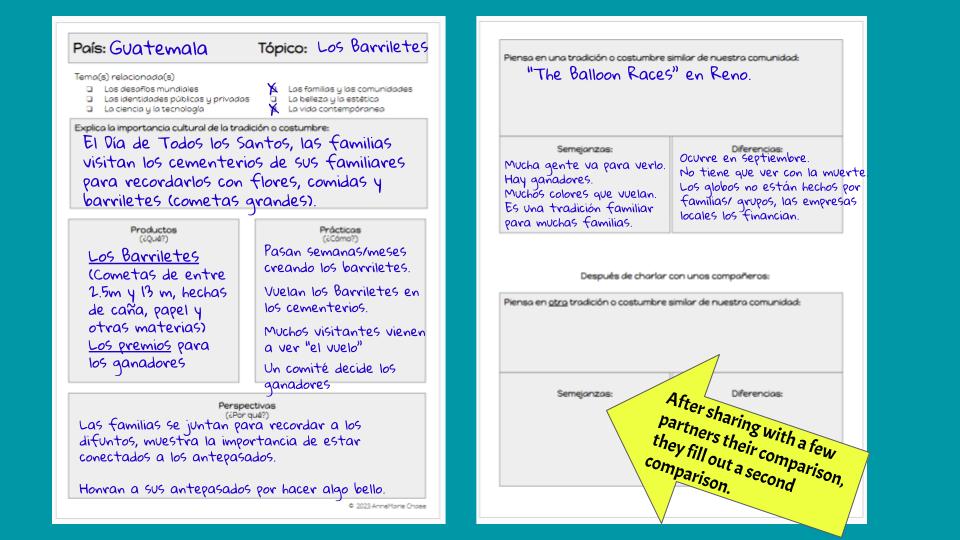
And because I don’t want these to get lost in their backpack black holes, I’ll be copying these babies on neon copy paper and they’ll (hopefully) keep them together in their binders. And, because we know that AP is built on everything that comes before, I am going to encourage my colleagues to do the same in Levels 1-4, so by the time they get to AP, they’ve got a boatload of cultural comparisons at their finger tips.
In addition to the paper Cultural Notetaker, I also want a digital ones that includes a bit more info for those Go-Getter types who want to “study” before the exam. (Those unicorn students exist, right?!). So, everyone will complete the paper notetaker every time, and one student will be assigned to make one digital slide with photos, videos and links about the current cultural topic. Those slides will be compiled into a Cultural Database that everyone can access.

Additionally, the assigned student will create 2 or 3 Multiple Choice questions using a google form about the Cultural Topic that will get dumped into a GimKit so we can review our cultural tidbits throughout the year. (Take their responses and copy and paste them into Gimkit’s “Import from a spreadsheet, TEMPLATE 1”.)
Of course new student will be assigned for each cultural topic and we’ll just keep rotating though our roster until we arrive at the test- and by that time we’ll have lots of cultural info, comparisons with our own community AND a GimKit to play that I didn’t have to create.
Welp, I have exactly ONE WEEK left of summer vacation before I head back to my classroom, then my Little Darlings arrive on Aug 21. Here’s to our best year yet, friends!
 Señora Chase
Gracias por compartir. I love the way that you format stuff. I have the same activities, but they don’t look nearly as nice, so it’s great to be able to update them or to be inspired by your design/format. Thanks for being so generous!
LikeLiked by 1 person
Gracias 🙂
LikeLike