I have a confession:
I often start a Card Talk and then get bored and abandon ship before we talk about everyone’s card. It is not right and I don’t feel good about this, but it’s the truth, folks.
Card Talk is fantastic tool, especially at the start of the year to learn their names and a bit about them….and it’s great for everyone else to get to know their classmates and oh yeah, and get loads of comprehensible input right out of the gate. Ideally you give a prompt like “Write your name on the card and draw something you love” (which is exactly what we’re doing in our first weeks of Spanish 2), then I pick a few to talk about every class, you know, doing what we do: Talking slowly, making comparisons, asking questions etc, until you talk about each students’ card. (For more complete instructions on How To Card Talk with a video demo, check out this post) But…maybe it’s my short attention span but after a few classes of talking about a few new students each time, I am over it and ready to move on to something else, but I feel guilty because I still have a stack of undiscussed cards.
Here are 2 variations that change up the regular Card Talk routine, so that you can still chat about everyone’s card AND keep it novel AND keep the CI flowing. I’d recommend you start out Card Talk like normal, and then when you’re ready to shake things up (and still have more dang cards to talk about) try one of these:
Muévete Si (Move if…)
Muévete si is an old standby in my classroom and is especially awesome when they are getting sleepy and bored and need to wake up. Here’s a post about good old Muévete si, if you want to see if without the Card Talk variation.
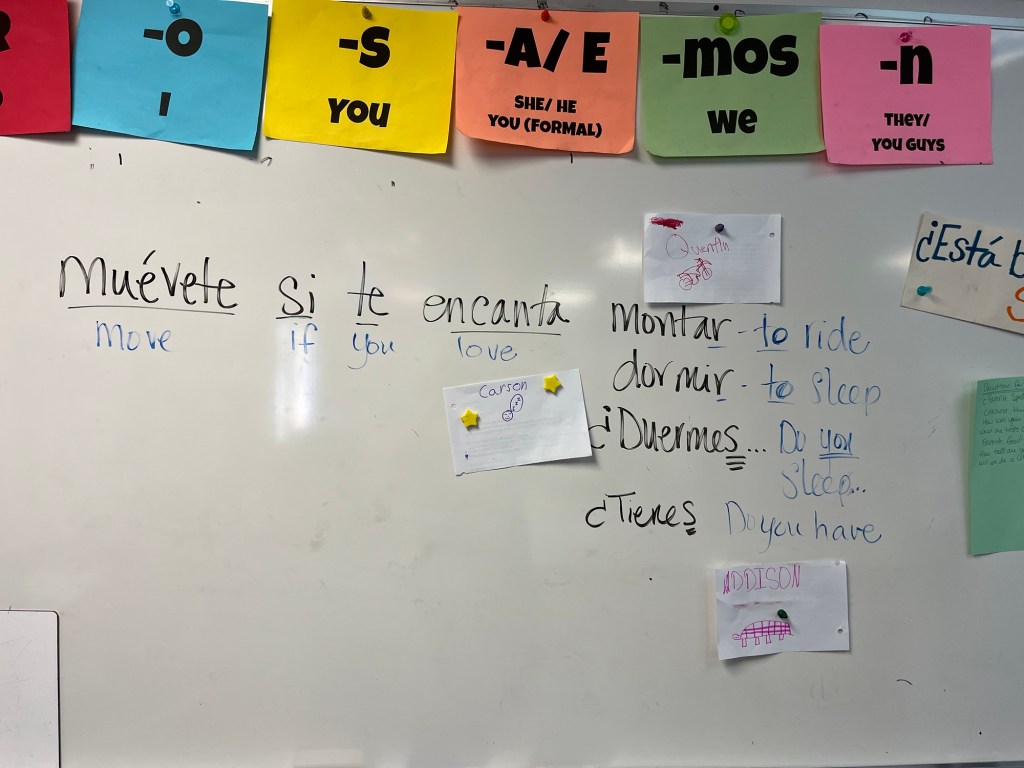
On the board you write: Muévete si (and make sure that’s comprehensible to them) and then something that will lead into your Card Talk prompt. Form my example above:
Muévete si te encanta… (Move if you love….)
Pull out an undiscussed card: Carson loves to sleep. Show everyone the card and tell them that Carson loves to sleep.
Point to the board: Muévete si te encanta… (Move if you love ….) and write dormir (to sleep). Then quickly start counting down from 5-1 in your target language. Everyone who also loves to sleep (including Carson) has to move to a new seat, before you finish the count down.
Say the phrase slowly (while pointing to the words), give everyone a chance to comprehend it, then count fast…it adds to the chaos and mayhem! They can’t move until you start counting and must hustle to be in a new seat once you start counting. One more rule: they have to move to a seat they haven’t previously sat in What happens if they are not in a new seat before you reach 1? Nothing, I just screech “MÁS RÁPIDO, DAVIN” and move on.
After that, ask a few follow up questions to the student who made the card. Carson, ¿Te encanta dormir? ¿Te encanta dormir en la escuela? (Carson, you love to sleep? Do you love to sleep at school?) Feign shock! ¿En qué clase? (In which class?) Back to the board, point and pause:
Muévete si también duermes en la escuela… 5-4-3-2-1 (Move if you sleep in school too…)
If you can think of more interesting questions for Carson, go for it, if you’re done, grab a new card and start a new one. The “Muévete si” sprinkled throughout makes it feel like a game and keeps my Little Darlings awake and engaged.
Oh, and one more thing…before you begin, ask everyone to tuck their backpacks under their chairs, to minimize the trip hazards! We are deskless so we have lots of room to move around, if you have desks, you might modify this to “Levántate si” (stand if) but I guarantee you it will not be as fun as dashing around the room looking for an empty chair.
Cierto/ Falso
Make it a guessing game. Pass out scratch paper and have them number 1-8 (or however many cards you have left!) Look at a card (without revealing it to students) and make a statement out loud:
- A Jacob le encanta correr (Jacob loves to run)
Students look at Jacob (make sure they know who Jacob is!) and guess whether the statement is True or False. They write down their guesses.
Grab another card and announce:
- A Paxton le encanta hacer snowboard en las montañas.
Again they guess if it’s true or false and jot it down
Another card, another statement:
- A Allie le encanta bailar con los videos de Just Dance.
Do 5 or 10 or as many as you want (I save this activity to finish up the stack),
Then we correct them (and give them lots more input), that sounds like this (but in Spanish, of course!)
- Jacob loves to run. What do you think? Jacob, don’t tell us! Who things that is true, that Jacob loves to run? Who thinks it’s false, that Jacob doesn’t like to run? (Dramatically reveal the card) FALSE! Jacob loves to lift weights. Jacob, do you like to run too? No, just lift weights. Where do you lift weights? How many pounds can you lift? Class, if you wrote down “False” you are right! Give yourself a point.
- What do you think? Does Paxton love to snowboard? Who thinks that it is true? Who thinks that it is false? (Dramatic reveal of Paxton’s card) You were right! Paxton loves to snowboard. Where do you snowboard, Paxton? Who else loves to snowboard at Kirkwood? Who wants to snowboard this winter? Everyone who wrote “True”, Paxton loves to snowboard gets a point.
And rinse and repeat to finish off the cards! Just another way to talk about them and their interests in a gamified way.
Of course at the end, we figure out who got the most correct and award a fabulous prize.

I hope everyone is off to a fantastic start of the school year…or you are soaking up the last bit of summer vacation before it’s time to head back. Last week I started my 20th year teaching Spanish…my goodness, how did that even happen?! I’m happy to report that week 1 went smoothly and I think my Little Darlings and I are going to have fun together this year. I wish the same for you!
Here’s to a joyful 2025-2026 School Year!
 Señora Chase
AWESOME ideas! Yes, I feel the guilt when, at the end of the year, I find the stack of cards I meant to get back to, but didn’t. Since I also do Special Person interviews in the same class, going back to the Day 1 cards seems redundant. I love and will use your ideas for using all of the cards at the beginning of the year.
Another idea: I sometimes pull out a card while co-creating a story during the year. For example, when we make a story about a student celebrating Mexico’s independence day, we talk about what the student did at the party, using what is on the card. It it surprising to provide an illustrated answer to a question later in the year. (Why didn’t Bob do X? Because … he was fishing! Who was he fishing with?)
LikeLike
[heart] ANNE TUMBUSCH reacted to your message:
LikeLike