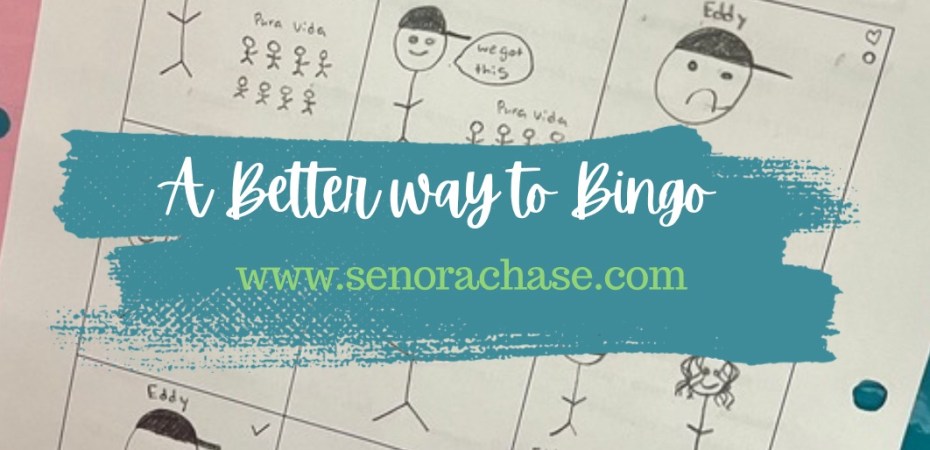
I’ve never been a big fan of Bingo, but I am loving this new variation: very low prep, lots of reading and interpreting involved AND it requires zero energy from the teacher. The Little Darlings run this one on their own. It’s the perfect game when you want them to do all the work because you need a break!
My very dear friend and Japanese teacher, Kathryn Tominaga, taught me this one; she learned it from an Instagram video. Who knows where the idea first originated, but I’ve made a few adjustments to make it work in my classroom. So far, we’ve played in Spanish 2, Spanish 4 and my Heritage classes, and it’s a winner!
To Prep:
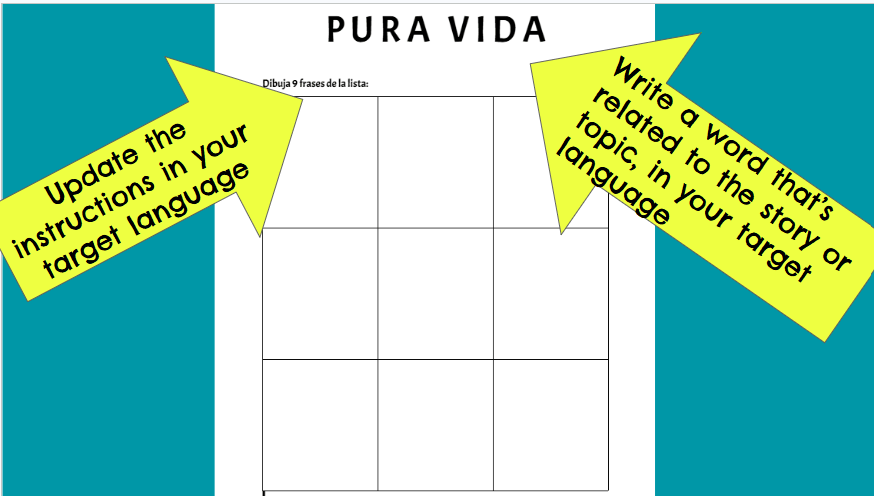
Make a copy of the Bingo Board Template, edit it for your target language, and make copies for all your Little Darlings:
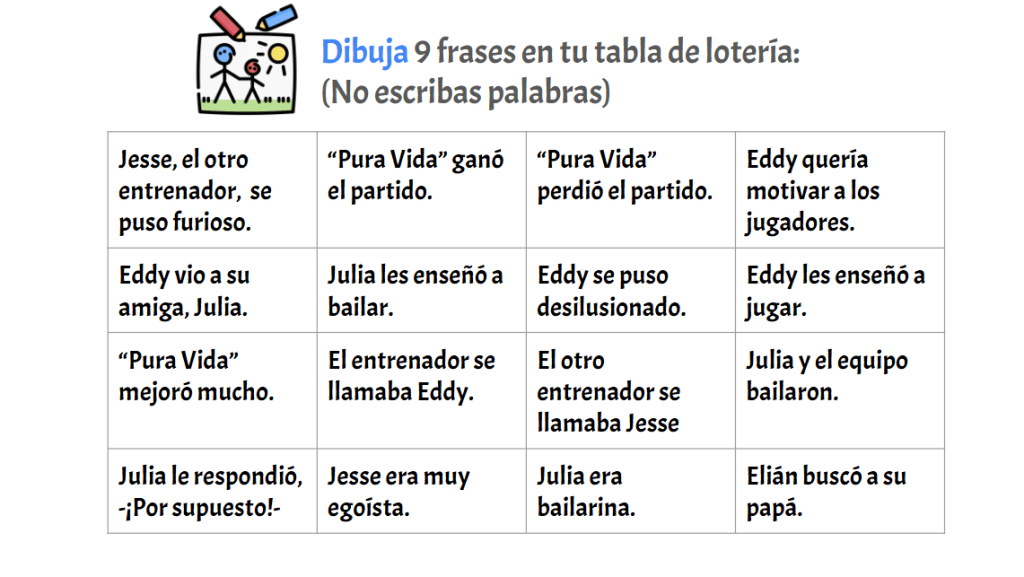
Make a slide with 16 sentences in a grid, to project for your Little Darlings. Now, I think it works best to write out sentences from a story you’ve created, or a Clip Chat you’ve done…something that your Little Darlings are familiar with. Here’s a great place to give them lots of examples of a specific grammar point. (Below, for my Sp 2s, this was their second exposure to the past tense, after reading the story written in the past tense the previous class).
To Play:
First project the slide of 16 sentences and make sure they’re comprehensible to your students. I like to have students read and volleyball translate them with a partner.
Then, ask students to illustrate 9 sentences on their Bingo Boards. Remind them that when you play bingo, everyone needs a unique board, so they should NOT confer with their partner as they create their boards. They should pick only 9 sentences, and illustrate them anywhere on their Bingo Board. There’s no free space; every square should have an illustration. You can decide how picky you want to be about how much they can write on their boards- there’s no harm in them writing the characters’ names, but you definitely don’t want them writing out entire sentences!
Since we all draw at different speeds, there are a few ways to manage it getting the boards finished:
- When half of the class was finished with their illustrations and the other half still needed time to draw: I taught the half with finished drawings how to play first, while the rest were drawing. Then I taught the second half how to play. This worked well, but took more energy on my end.
- Alternately, you could give them a 3 or 4 minute warning that they need to have their illustrations finished, and the fast finishers could add more details to their illustrations. (I tried both ways, both ways worked. Follow your heart, here)
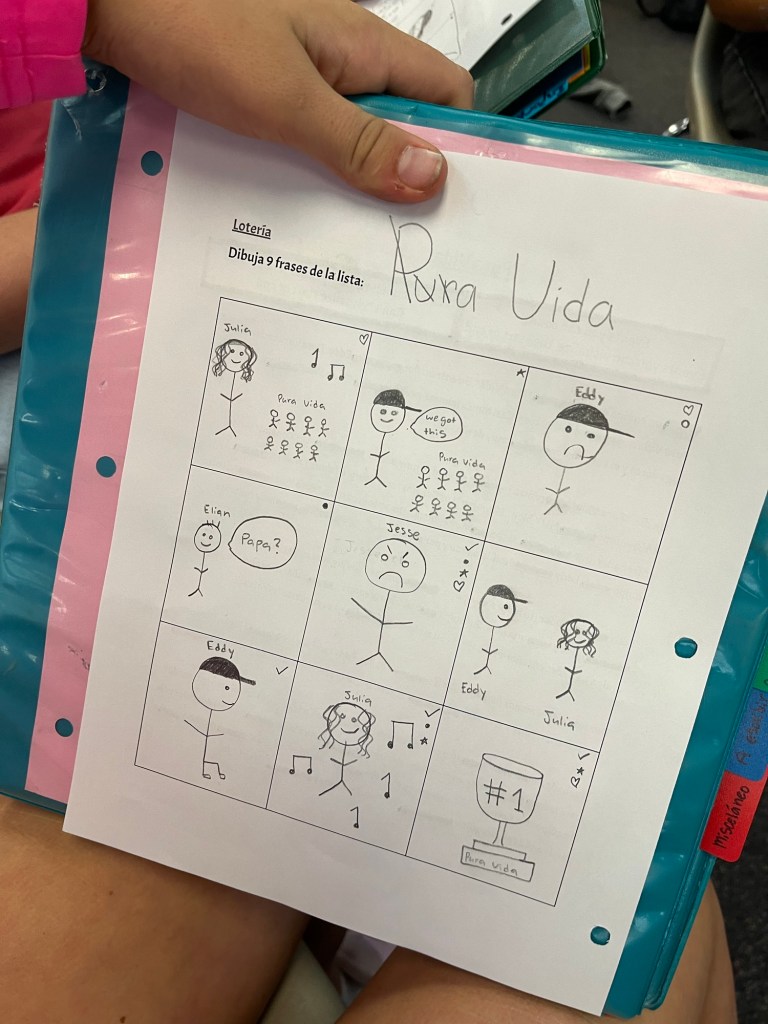
Then put students in groups of 3 or 4 students. (In the original Instagram explanation, they played with 2 people, but we tested out pairs, 3s and 4s and everyone agrees, its more fun with more friends!)
For the first round, everyone in the group agrees on a symbol to mark their boards. (Maybe it’s a tiny triangle the first round, then a smiley face for the 2nd round and a star for the 3rd round- each group will decide on a new symbols before the subsequent rounds).
One player from each group, (we’ll call him The Caller) says a sentence that they’ve illustrated on their board and marks the corresponding square, using their agreed upon symbol. The slide is still displayed, supporting The Callers as they say their chosen sentence. Everyone else in the group also marks their corresponding square if they have that sentence illustrated on their own board. Then The Caller role switches to the the next person in the group, who calls a sentence that they’ve illustrated on their board, and marks it with the same symbol. Everyone else marks it on their board, if they have that picture on their own board. And so on, rotating The Caller each turn until someone in the group gets 3 in a row, either vertically, horizontally or diagonally. They holler out Bingo or Lotería or whatever you want and the winner crosses off the first letter across the top of the board. The game is not over, round 1 is over.
Then the group picks a new symbol, and begins the next round, with a different student starting the game as The Caller. Everyone plays with the new symbol, ignoring the symbols from previous rounds.
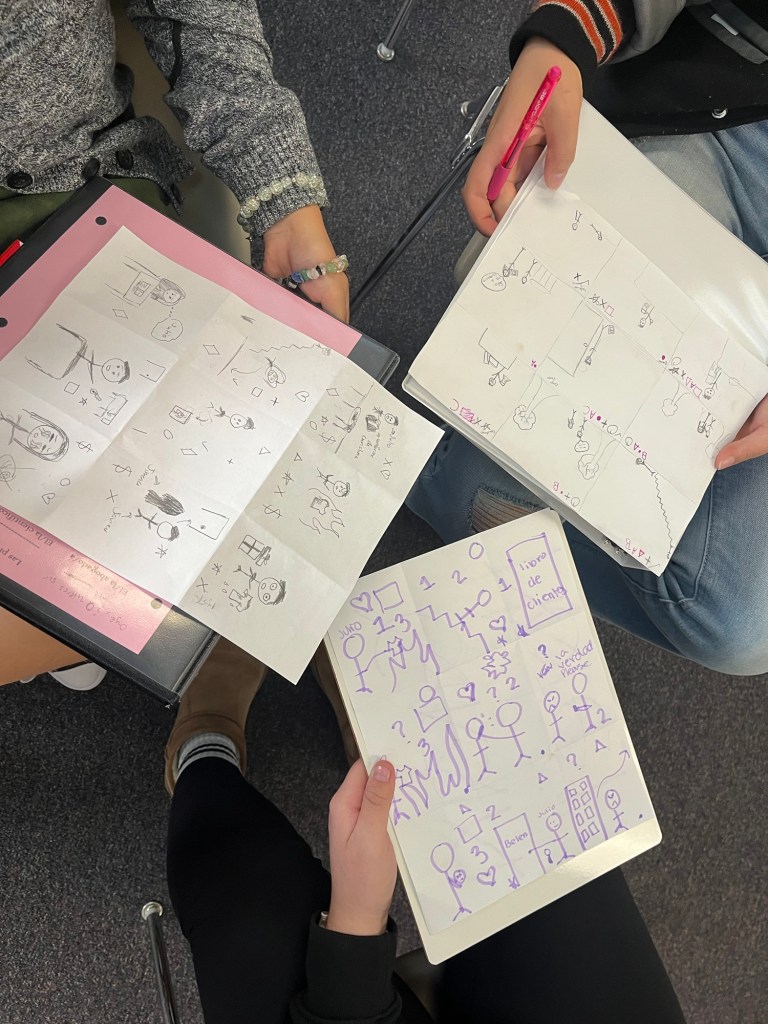
Important note: all groups are playing simultaneously, taking turns calling out a sentence while everyone in the group marks their boards. Each group begins a new round as soon as someone has marked off 3 in a row. The teacher is circulating the classroom or sipping her tea with her feet up while thanking Jesus that the Little Darlings are managing the game without any help.
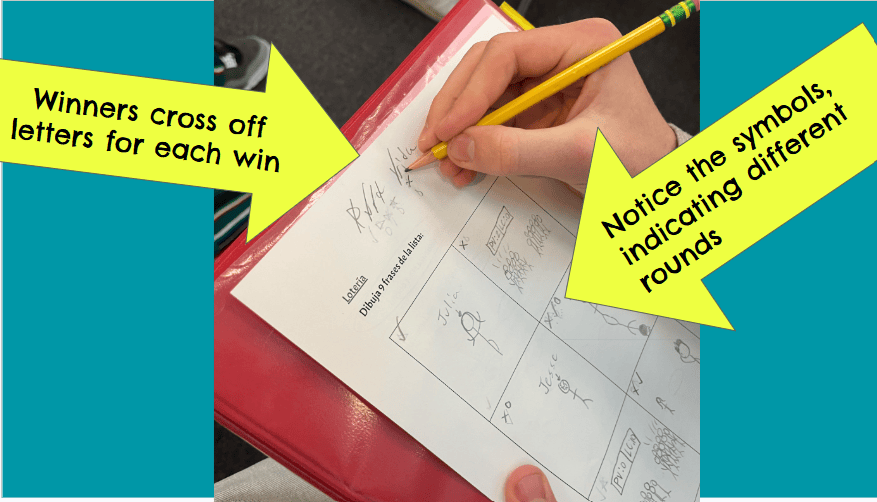
After about 10 minutes or so, shuffle the teams. I love using Flippity’s Random Name Picker to make new groups, but you do you. Then begin playing again, using their same board, but keeping the letters they’ve already crossed off. Let’s imagine that Little Maclin has won twice and crossed off the P and the U at the top of his board. Señora Chase shuffles the groups and Maclin wins again with his new group, so he crosses off the R at the top of his board, indicating his third win.
Play until their interest wanes or you have a student who has crossed off all the letters at the top of the board. If you stop the game before someone has crossed off all the letters, the students with the most letters crossed off wins.
To get even more bang for your buck:
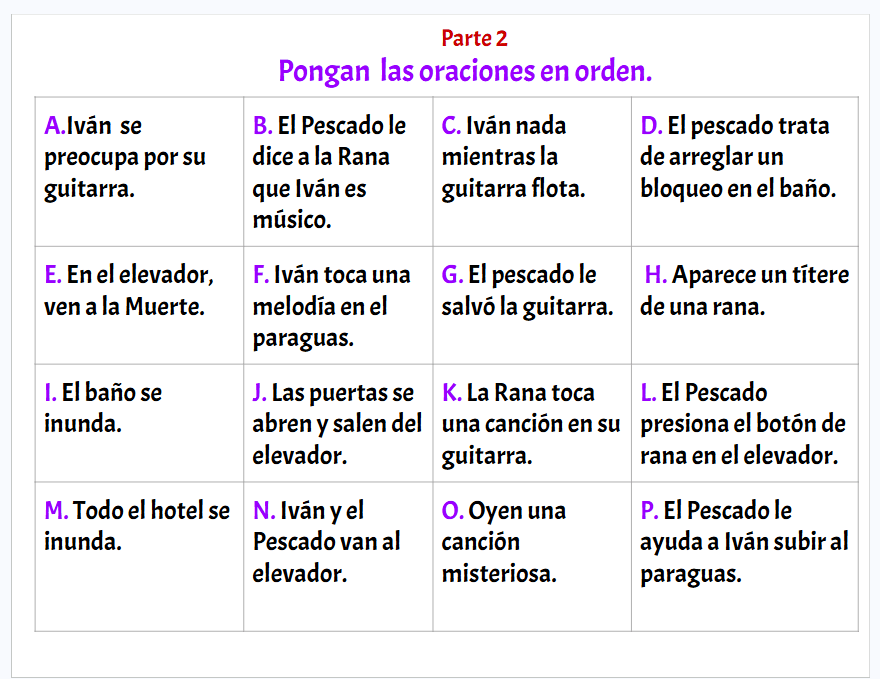
Write your sentences in a random order and ask students to put them in the correct order as a pre-game reading activity. To make this task less laborious for them, I added a letter to each slide to use as they ordered the sentences with a partner on a mini whiteboard. They just wrote the letter, instead of the whole sentence. Be sure to make a copy and show them the slide with the letters ONLY for the pre or post game activity, not during the game itself! You want students to read off the whole sentence, not just the letter while they’re playing. Here’s what this looked like in my Heritage 1 class, based on the cortometraje Suerte:
Another post play extension: We brainstormed connecting words on the board, like “aunque”, “por eso”, “sin embargo”, “De repente”, etc, and then working alone, my Heritage Little Darlings combined the simple sentences above to create “juicy” sentences, as my co author Andrea Caulfield calls them in our new book, Proficiency through Play. They wrote our juicy complex sentences as I circulated and lavished praise on them.
Hope you’re having a lovely fall and your Little Darlings are behaving and acquiring lots!
PS- We still have space on our Segovia PD Workshop, if you’re thinking about next summer already!.